A big question about quasars: do very young quasars have a spherical shape like a star or do they have a different shape. Also, are they like stars such as having fusion on the surfaces. I know they are not black holes in galaxies, since black holes (and neutron stars) don't exist. So what would a young quasar look like close up. Could they temporarily form solar systems and be gravitationally associated with stars like double stars and the like. I've been trying to find out about this. Quasars have always fascinated me; and they fascinate me even more now that they are electrical phenomena like stars.
Finally another question. It is said that if Jupiter were in interstellar space, it would turn into a brown dwarf with a reddish anode discharge around it. Would a body the size of the Earth or even the moon behave like that? I did read that a Neptune massed planet had a far greater temperature than its host star. If it is in arc mode it would have to be a star, rather than a planet--or can it be both? Thanks in advance.
Quasars...
-
Xuxalina Rihhia
- Posts: 107
- Joined: Sat May 24, 2008 6:53 pm
Re: Quasars...
I am talking about quasars in terms of an electric universe, not black holes/white holes which do not exist.
Thanks in advance.
Thanks in advance.
-
Solar

- Posts: 1372
- Joined: Mon Mar 17, 2008 3:05 am
Re: Quasars...
LOL!! Bumpity--Bump. Just hang on a sec there Xuxalina.
You can start reviewing quasars over at the Thunderbolts TPOD archive.
There is also a Search function on the Holoscience web page, just type the word quasar in.
In addition, Anthony Peratt has papers on the subject at Plasma Universe.
If you want to speed things up a bit when reading the Holoscience articles brought back with its search function you can do this with each article:
Hit - Cntrl+F
This will open a Search function in your web browser for the web page or article that the browser is currently displaying. Just type the word quasar in and it will list all references in the article being shown. You can then move through each refernce one at a time. You just have to make sure you get the context of the subject correct.
You can start reviewing quasars over at the Thunderbolts TPOD archive.
There is also a Search function on the Holoscience web page, just type the word quasar in.
In addition, Anthony Peratt has papers on the subject at Plasma Universe.
If you want to speed things up a bit when reading the Holoscience articles brought back with its search function you can do this with each article:
Hit - Cntrl+F
This will open a Search function in your web browser for the web page or article that the browser is currently displaying. Just type the word quasar in and it will list all references in the article being shown. You can then move through each refernce one at a time. You just have to make sure you get the context of the subject correct.
"Our laws of force tend to be applied in the Newtonian sense in that for every action there is an equal reaction, and yet, in the real world, where many-body gravitational effects or electrodynamic actions prevail, we do not have every action paired with an equal reaction." — Harold Aspden
-
Xuxalina Rihhia
- Posts: 107
- Joined: Sat May 24, 2008 6:53 pm
Re: Quasars...
I found the answers to someof my questions here:
http://www.thunderbolts.info/tpod/2010/ ... harged.htm
Quasars: Massive or Charged?
Aug 19, 2010
Consensus theories of the cosmos presume that mass is the fundamental quality with which to explain phenomena. For example, quasars are considered to be massive accretions of matter into supermassive black holes at a galaxy’s nucleus.
Because mass attracts mass, astronomers easily imagine that galaxies attract galaxies and that collisions, mergers, and tidal disruptions are common. Merging galaxies should massively increase the matter accreting into their nuclear black holes, and so astronomers expected to see many binary quasars among the collisions. Until recently, they have been disappointed.
However, a new series of images has found two close quasars in the midst of two close galaxies with distorted tails (image above). The tails could be nothing other than tidal disruptions from the merging of the galaxies, and the quasars are therefore indisputable confirmation of consensus theory. Should anyone have any doubts, a computer simulation of merging galaxies has “corroborated this conclusion.” “The model verifies the merger origin for this binary quasar system,” averred the model-maker.
Consensus, of course, being a massive merger of opinion, seldom takes notice of wisps of dissent. But those who read marginalia will spot a few disagreements. ‘To corroborate’ appears to mean ‘to program a computer with the same assumptions used to interpret observations and to generate features similar to the observations.’ (But what else can you do with an object that’s so far away you can’t stick your thumb in the pie to test it as Jack Horner did?) “The model verifies the merger” is one of those wheels of logic that provides exercise for astrophysical gerbils.
Another comment questions the certainty that “tails…are a sure sign…of an ongoing galaxy merger.” One can be sure of any belief merely by pumping up one’s fervency. But a scientific theory should be instead reliable, which requires alternative theories to be sought out and tested as well: What else could the phenomenon be under other assumptions? The consensus theories appear to produce excuses instead of tests. Readers of this site will likely think of several alternatives that could provide tests for reliability of the “sure signs.”
The Electric Universe is one of several alternative plasma theories that presume charge is the fundamental quality with which to explain phenomena. It takes a hint provided at the end of the press release (first link above) that “the galaxy disks both appear to be nearly face-on to Earth” and “the X-rays from Chandra show no signs of absorption by intervening gas or dust.”
In the Electric Universe, quasars are plasmoids ejected, usually along the spin axis, from a plasma focus mechanism in a galaxy’s nucleus. A face-on disk means that we are looking ‘down the barrel.’ An ejected quasar would appear projected against the galaxy’s core. It would be interesting to obtain a spectrum of the tails apart from the central quasars to see if they have a lower redshift. If they do, this would be another instance of a higher-redshift quasar in front of a lower-redshift galaxy.
Of course, the two quasars may instead be part of a fragmented ejection (from an active galaxy outside the field of view) and are starting to evolve into companion galaxies. After all, they lie on the eastern edge of the Virgo Cluster, where much ejection activity is occurring.
My question now is why Quasars are donut shaped instead of spherical and why stars are spherical instead of donut shaped. Both stars and quasars must have electrically driven nuclear reactions on their "surfaces."
http://www.thunderbolts.info/tpod/2010/ ... harged.htm
Quasars: Massive or Charged?
Aug 19, 2010
Consensus theories of the cosmos presume that mass is the fundamental quality with which to explain phenomena. For example, quasars are considered to be massive accretions of matter into supermassive black holes at a galaxy’s nucleus.
Because mass attracts mass, astronomers easily imagine that galaxies attract galaxies and that collisions, mergers, and tidal disruptions are common. Merging galaxies should massively increase the matter accreting into their nuclear black holes, and so astronomers expected to see many binary quasars among the collisions. Until recently, they have been disappointed.
However, a new series of images has found two close quasars in the midst of two close galaxies with distorted tails (image above). The tails could be nothing other than tidal disruptions from the merging of the galaxies, and the quasars are therefore indisputable confirmation of consensus theory. Should anyone have any doubts, a computer simulation of merging galaxies has “corroborated this conclusion.” “The model verifies the merger origin for this binary quasar system,” averred the model-maker.
Consensus, of course, being a massive merger of opinion, seldom takes notice of wisps of dissent. But those who read marginalia will spot a few disagreements. ‘To corroborate’ appears to mean ‘to program a computer with the same assumptions used to interpret observations and to generate features similar to the observations.’ (But what else can you do with an object that’s so far away you can’t stick your thumb in the pie to test it as Jack Horner did?) “The model verifies the merger” is one of those wheels of logic that provides exercise for astrophysical gerbils.
Another comment questions the certainty that “tails…are a sure sign…of an ongoing galaxy merger.” One can be sure of any belief merely by pumping up one’s fervency. But a scientific theory should be instead reliable, which requires alternative theories to be sought out and tested as well: What else could the phenomenon be under other assumptions? The consensus theories appear to produce excuses instead of tests. Readers of this site will likely think of several alternatives that could provide tests for reliability of the “sure signs.”
The Electric Universe is one of several alternative plasma theories that presume charge is the fundamental quality with which to explain phenomena. It takes a hint provided at the end of the press release (first link above) that “the galaxy disks both appear to be nearly face-on to Earth” and “the X-rays from Chandra show no signs of absorption by intervening gas or dust.”
In the Electric Universe, quasars are plasmoids ejected, usually along the spin axis, from a plasma focus mechanism in a galaxy’s nucleus. A face-on disk means that we are looking ‘down the barrel.’ An ejected quasar would appear projected against the galaxy’s core. It would be interesting to obtain a spectrum of the tails apart from the central quasars to see if they have a lower redshift. If they do, this would be another instance of a higher-redshift quasar in front of a lower-redshift galaxy.
Of course, the two quasars may instead be part of a fragmented ejection (from an active galaxy outside the field of view) and are starting to evolve into companion galaxies. After all, they lie on the eastern edge of the Virgo Cluster, where much ejection activity is occurring.
My question now is why Quasars are donut shaped instead of spherical and why stars are spherical instead of donut shaped. Both stars and quasars must have electrically driven nuclear reactions on their "surfaces."
-
GaryN

- Posts: 2668
- Joined: Tue Apr 01, 2008 8:18 pm
- Location: Sooke, BC, Canada
Re: Quasars...
I have my ideas of what powers all these objects, but super massive black holes are still proposed as the power source of all these events. This guy has some good graphics explaining the structures and fields, he just needs to change his concept of the black hole.
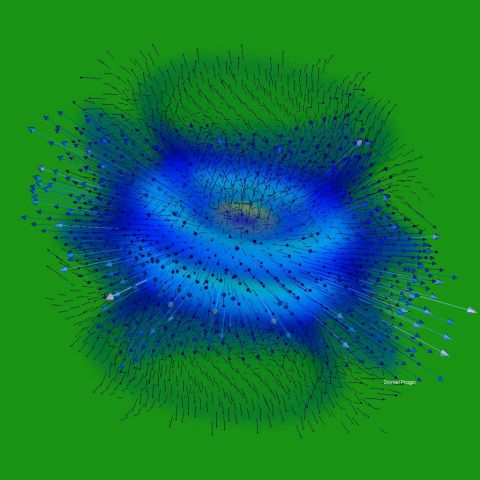
http://www.physics.unlv.edu/~dproga/
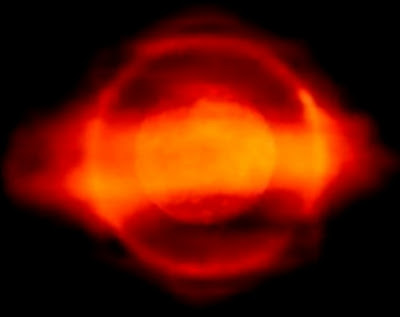
On the active Sun, you can see the dual toroids,
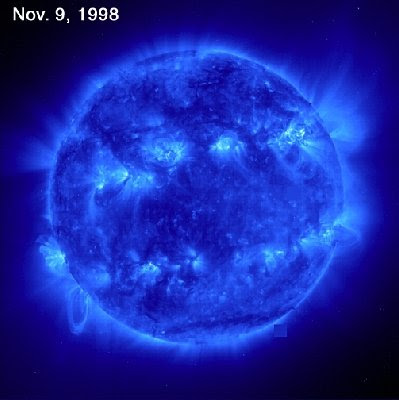
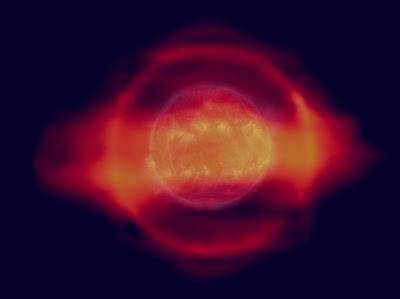
and mgmirkin has combined the above images
 g
g
I had thought that a torus internal to the Sun was causing the surface features, but it might well be that charge spikes on the exterior torus are sucking charge off the surface.
mgmirkins article can be found on this thread:
http://www.bautforum.com/showthread.php ... Arctic!%29
I have to wonder too about the similarity of the hydrogen wave function diagrams to many of the structures so far identified in space.
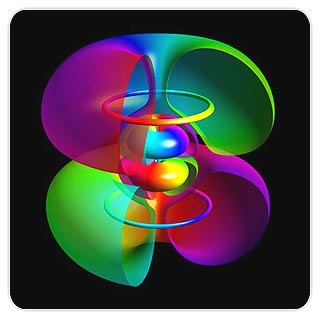
I see the Van Allen belts, and the Ant Nebula amongst these images. Coincidence?

http://www.physics.unlv.edu/~dproga/
The torus is the primary structure produced by whatever the central event really is, and, from antenna field theory, the sphere is a result of the combined toroidal and poloidal loop fields.My question now is why Quasars are donut shaped instead of spherical and why stars are spherical instead of donut shaped. Both stars and quasars must have electrically driven nuclear reactions on their "surfaces."
On the active Sun, you can see the dual toroids,
and mgmirkin has combined the above images
I had thought that a torus internal to the Sun was causing the surface features, but it might well be that charge spikes on the exterior torus are sucking charge off the surface.
mgmirkins article can be found on this thread:
http://www.bautforum.com/showthread.php ... Arctic!%29
I have to wonder too about the similarity of the hydrogen wave function diagrams to many of the structures so far identified in space.
I see the Van Allen belts, and the Ant Nebula amongst these images. Coincidence?
In order to change an existing paradigm you do not struggle to try and change the problematic model. You create a new model and make the old one obsolete. -Buckminster Fuller
-
plasmadragon

- Posts: 10
- Joined: Thu Apr 08, 2010 12:27 pm
- Location: Vermont, USA
- Contact:
-
Lloyd
- Posts: 4433
- Joined: Fri Apr 04, 2008 2:54 pm
Re: Quasars...
XR said:
* Why do you say that quasars are donut-shaped? EU theorists call them plasmoids, which I think are generally spherical. The torus-shaped forces within or around them aren't usually visible. Here's a thread that compares quasars to high velocity stars: http://www.thunderbolts.info/wp/forum/phpB ... 260#p16318. Stars may be formed in a very similar way to what quasars are.My question now is why Quasars are donut shaped instead of spherical and why stars are spherical instead of donut shaped. Both stars and quasars must have electrically driven nuclear reactions on their "surfaces."
-
Xuxalina Rihhia
- Posts: 107
- Joined: Sat May 24, 2008 6:53 pm
Re: Quasars...
Then are Quasars gigantic stars under immense electrical stress or something slightly different?
Here's more information I found at TPOD's archive:
http://www.thunderbolts.info/tpod/2010/ ... gstars.htm
Here's more information I found at TPOD's archive:
http://www.thunderbolts.info/tpod/2010/ ... gstars.htm
In the Electric Universe, a quasar is highly charged matter under great electrical stress. One characteristic of a quasar is that its spectrum shows a blue continuum and very few emission lines. This is attributed to the Stark effect, which causes emission lines in a strong electric field to spread out in proportion to the field strength. Lines of lighter elements are spread more than lines of heavier ones, so a strong electrical field, such as would exist in a quasar, could easily smear the blue Hydrogen lines into a continuum.
-
Nereid
- Posts: 744
- Joined: Tue Nov 09, 2010 11:21 am
Re: Quasars...
Spurred by the discussion in this Thunderbolts Forum thread, I have searched for anything on what, to EU theorists and Thunderbolts Forum members, constitutes an observational definition of a quasar; that is, from data obtained by various telescopes/cameras/detectors/etc, how does one go about deciding if a source/object in that data is a "quasar"?Solar wrote:LOL!! Bumpity--Bump. Just hang on a sec there Xuxalina.
You can start reviewing quasars over at the Thunderbolts TPOD archive.
There is also a Search function on the Holoscience web page, just type the word quasar in.
In addition, Anthony Peratt has papers on the subject at Plasma Universe.
If you want to speed things up a bit when reading the Holoscience articles brought back with its search function you can do this with each article:
Hit - Cntrl+F
This will open a Search function in your web browser for the web page or article that the browser is currently displaying. Just type the word quasar in and it will list all references in the article being shown. You can then move through each refernce one at a time. You just have to make sure you get the context of the subject correct.
Unfortunately, I couldn't find anything (thanks to Solar for this easy to use set of links; I began my search with them).
Does anyone know of any such material/reference/etc?
By the way, I am somewhat familiar with the history of the term and how its meaning has changed over the several decades since the 1960s; I am also aware that, today, observational astronomers tend to use a more general term, AGN (short for active galaxy nucleus, or galaxy with an active nucleus), and that 'quasar' tends to be reserved for AGNs whose estimated intrinsic luminosity is greater than a certain value. Of course, in the EU paradigm this makes no sense, because 'intrinsic luminosity' is estimated using the Hubble redshift-distance relationship.
-
Jarvamundo

- Posts: 612
- Joined: Fri Feb 05, 2010 5:26 pm
- Location: Australia
Re: Quasars...
Errr.... using the hubble relationship makes no sense to anyone who looks at the resulting graph. Way way way off the hubble's trend line.Nereid wrote:Of course, in the EU paradigm this makes no sense, because 'intrinsic luminosity' is estimated using the Hubble redshift-distance relationship.
Seems, Hubble has good reason to doubt his own relationship.
http://www.deceptiveuniverse.com/Redshi ... uasars.jpg

-
GaryN
- Posts: 2668
- Joined: Tue Apr 01, 2008 8:18 pm
- Location: Sooke, BC, Canada
Re: Quasars...
http://www.see.org/garcia/e-ct-1.htm#17In summary, the preponderance of evidence indicates that quasars are very distant objects with masses at least as great as a galaxy, sizes often not much greater than a solar system, and energy outputs so enormous that no known physical process - except possibly the collapse of a galaxy into a black hole at its nucleus - can explain them. If the mass of a galaxy were being converted to energy at the same rate as it is in a quasar, it would only last about 100,000 years; yet all the observed galaxies seem to be many billions of years old. But perhaps the destiny of all galaxies is to collapse into black holes.
....
Therefore, we are left with the inescapable conclusion that quasars are at extreme cosmological distances and/or all the models of the universe are in serious error. The latter case is not improbable.
from:THE EVOLUTION OF MATTER
http://www.see.org/garcia/e-ct-1.htm
In order to change an existing paradigm you do not struggle to try and change the problematic model. You create a new model and make the old one obsolete. -Buckminster Fuller
-
Nereid
- Posts: 744
- Joined: Tue Nov 09, 2010 11:21 am
Re: Quasars...
One more post for today (that'll be four, in total).
Thanks Jarvamundo, GaryN; however, my question - what (to EU theorists and Thunderbolts Forum members) is the (or an) observational definition of a 'quasar'? - remains unanswered.
Perhaps a concrete example or two might help.
Consider 3C223, a.k.a. SDSS J093952.75+355358.7. It has a redshift of 0.1367, and a spectrum that is dominated by emission lines (in the optical); however, apart from a very bright nucleus, it looks like a typical giant elliptical galaxy. To EU theorists and Thunderbolts Forum members, is this a quasar? If so, why (and if not, why not)?
Or 3C323.1 (a.k.a. SDSS J154743.53+205216.6. It has a redshift of 0.2643, and a spectrum that is also dominated by emission lines (in the optical, though the continuum is much more prominent than in that of 3C223), and there's little or no sign of any underlying galaxy (the Petrosian radius, at 1.4", is slightly bigger than that of a star of comparable magnitude, and there may be a hint of some 'fuzz' off to the NW). To EU theorists and Thunderbolts Forum members, is this a quasar? If so, why (and if not, why not)?
Thanks Jarvamundo, GaryN; however, my question - what (to EU theorists and Thunderbolts Forum members) is the (or an) observational definition of a 'quasar'? - remains unanswered.
Perhaps a concrete example or two might help.
Consider 3C223, a.k.a. SDSS J093952.75+355358.7. It has a redshift of 0.1367, and a spectrum that is dominated by emission lines (in the optical); however, apart from a very bright nucleus, it looks like a typical giant elliptical galaxy. To EU theorists and Thunderbolts Forum members, is this a quasar? If so, why (and if not, why not)?
Or 3C323.1 (a.k.a. SDSS J154743.53+205216.6. It has a redshift of 0.2643, and a spectrum that is also dominated by emission lines (in the optical, though the continuum is much more prominent than in that of 3C223), and there's little or no sign of any underlying galaxy (the Petrosian radius, at 1.4", is slightly bigger than that of a star of comparable magnitude, and there may be a hint of some 'fuzz' off to the NW). To EU theorists and Thunderbolts Forum members, is this a quasar? If so, why (and if not, why not)?
-
starbiter

- Posts: 1445
- Joined: Mon Mar 17, 2008 9:11 am
- Location: Antelope CA
- Contact:
Re: Quasars...
If this Tpod is already under discussion i apologize.
http://thunderbolts.info/tpod/2004/arch ... galaxy.htm
http://thunderbolts.info/tpod/2004/arch ... galaxy.htm
I Ching #49 The Image
Fire in the lake: the image of REVOLUTION
Thus the superior man
Sets the calender in order
And makes the seasons clear
www.EU-geology.com
http://www.michaelsteinbacher.com
Fire in the lake: the image of REVOLUTION
Thus the superior man
Sets the calender in order
And makes the seasons clear
www.EU-geology.com
http://www.michaelsteinbacher.com
-
Solar
- Posts: 1372
- Joined: Mon Mar 17, 2008 3:05 am
Re: Quasars...
Hello again Nereid.Nereid wrote:... - what (to EU theorists and Thunderbolts Forum members) is the (or an) observational definition of a 'quasar'? - remains unanswered.
As a TB forum member and someone interested in the goings on of Astrophysics & Cosmology I can only convey my personal interpretation with regard to this question. In a post from "Eclipsing Cepheid Falsifies Stellar Evolution Theory" you referred to those interested in astro-anything by way of GalaxyZoo as "citizen scientist."
It is not the case that I, Solar, have coined an "observational definition" of a Quasar, QSO, AGN etc - but that this (and many other terms quantified and qualified by their particulars) is what has been provided by those who work in that field. The same applies with the "citizen scientist" participating in the Galaxy Zoo project (yes, I have an account there as well). Their 'observational definition' of a Quasar is what the naming convention of the genre says it is. From my vantage point there is ostensibly no difference between the "citizen scientist" at Galaxy Zoo and several of the "citizen scientist" here on the Thunderbolts Fourm.
Getting the public involved in the science that their money pays for, or helps to, is a good idea. Especially when it facilitates a better understanding of the talent that goes on under the hood. That being said, for some bizarre reason I get the distinct impression that GZ gets a pass because it is 'officially sanctioned.' Whereas someplace like the TB Forum seems to rate with 'a teacher' taking a walk across the hall to see what the kids in detention are up to!!

You know, the ones who actually had the nerve and audacity to simply disagree with the 'teacher' about the day's lesson. As if no other qualified 'teachers' (or even someone with a demonstrably good idea) haven't done the same thereby providing second, third, and even fourth considerations on the particulars.
"Our laws of force tend to be applied in the Newtonian sense in that for every action there is an equal reaction, and yet, in the real world, where many-body gravitational effects or electrodynamic actions prevail, we do not have every action paired with an equal reaction." — Harold Aspden
-
starbiter
- Posts: 1445
- Joined: Mon Mar 17, 2008 9:11 am
- Location: Antelope CA
- Contact:
Re: Quasars...
Hello Nereid and Physicist: The TPOD i mentioned yesterday is the smoking gun for redshift being only a measure of retreating speed and distance, IMO.
http://thunderbolts.info/tpod/2004/arch ... galaxy.htm
[...]
Why does this prove the big bang wrong? One of the two major foundations of the big bang is that redshift is proportional to distance. That means the larger the redshift of an object, the farther away it must be. The other major foundation of the big bang is that all redshift is a measure of velocity. Again, the larger the redshift of an object, the faster it is moving away from us. Combined, these two foundations become the expanding universe, which can be traced backwards to the big bang.
Look at the picture again. By the big bang principles, this quasar must be billions of light years farther from us than the galaxy, because its redshift is so much larger. And yet the galaxy is opaque, so the quasar must be near the surface of the dust clouds or even in front of them.
Me again,
I look forward to comments from both of you.
michael
http://thunderbolts.info/tpod/2004/arch ... galaxy.htm
[...]
Why does this prove the big bang wrong? One of the two major foundations of the big bang is that redshift is proportional to distance. That means the larger the redshift of an object, the farther away it must be. The other major foundation of the big bang is that all redshift is a measure of velocity. Again, the larger the redshift of an object, the faster it is moving away from us. Combined, these two foundations become the expanding universe, which can be traced backwards to the big bang.
Look at the picture again. By the big bang principles, this quasar must be billions of light years farther from us than the galaxy, because its redshift is so much larger. And yet the galaxy is opaque, so the quasar must be near the surface of the dust clouds or even in front of them.
Me again,
I look forward to comments from both of you.
michael
Last edited by davesmith_au on Wed Jan 19, 2011 3:52 pm, edited 1 time in total.
Reason: URL fix - DS.
Reason: URL fix - DS.
I Ching #49 The Image
Fire in the lake: the image of REVOLUTION
Thus the superior man
Sets the calender in order
And makes the seasons clear
www.EU-geology.com
http://www.michaelsteinbacher.com
Fire in the lake: the image of REVOLUTION
Thus the superior man
Sets the calender in order
And makes the seasons clear
www.EU-geology.com
http://www.michaelsteinbacher.com
Who is online
Users browsing this forum: No registered users and 17 guests