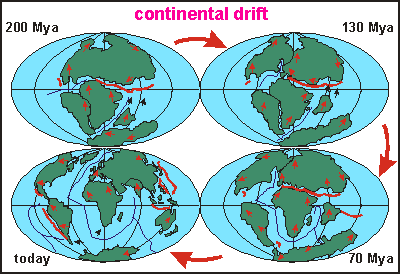
It's been demonstrated to my satisfaction that this "supercontinent" or "pangea" idea is absolute bunk. The continents don't fit together well on a planet the size of Earth today. They do, however, fit together almost perfectly on a planet much smaller (around 60% the present size of Earth, I believe) planet. Earth expansion is a logical conclusion of the observed fact that many tons of material rain down on Earth every day from space. Obviously as a result of such a hail of material the Earth's radius is increasing. I believe much of this material is pushed into the interior of Earth in a process much like electroplating, through the "spreading sea floor", where we observe volcanic activity (clear signs of electrical activity).Lloyd wrote:
Earth Was a Moon of Saturn
-
StalkingGoogle
- Guest
"supercontinent" bunk and expanding Earth
-
orrery

- Posts: 383
- Joined: Wed Nov 03, 2010 12:04 pm
- Location: USA
Re: "supercontinent" bunk and expanding Earth
I am in agreement with your conclusion. I believe the Plasma Fountains of the Earth and phenom such as the Aurora, present us with evidence of oxygen ion interactions with the solar wind and flare activity allowing water to fall on the earth.StalkingGoogle wrote:It's been demonstrated to my satisfaction that this "supercontinent" or "pangea" idea is absolute bunk. The continents don't fit together well on a planet the size of Earth today. They do, however, fit together almost perfectly on a planet much smaller (around 60% the present size of Earth, I believe) planet. Earth expansion is a logical conclusion of the observed fact that many tons of material rain down on Earth every day from space. Obviously as a result of such a hail of material the Earth's radius is increasing. I believe much of this material is pushed into the interior of Earth in a process much like electroplating, through the "spreading sea floor", where we observe volcanic activity (clear signs of electrical activity).Lloyd wrote:
"though free to think and to act - we are held together like the stars - in firmament with ties inseparable - these ties cannot be seen but we can feel them - each of us is only part of a whole" -tesla
http://www.reddit.com/r/plasmaCosmology
http://www.reddit.com/r/plasmaCosmology
-
Lloyd
- Posts: 4433
- Joined: Fri Apr 04, 2008 2:54 pm
Re: Earth Was a Moon of Saturn
* I'm rephrasing the Thread Summary for "Earth Was a Moon of Saturn".
Saturn Theories
http://thunderbolts.info/wp/forum/phpBB3/v ... 932#p55937
* This theory is accepted by most or all of the Thunderbolts team. Cardona found a plausible mechanism for the ancient shish-kabob arrangement of Saturn's planets. Saturn, as a brown dwarf star outside the Solar System, behaved like a comet, with Mars and Earth following behind it, similar to the way the SL9 comet fragments trailed behind each other in a near straight line. That's why the ancients saw Saturn usually as stationary over the north pole.
Earth's Oval to Spherical Form
http://thunderbolts.info/wp/forum/phpBB3/v ... =15#p56045
http://thunderbolts.info/wp/forum/phpBB3/v ... =45#p56331
http://thunderbolts.info/wp/forum/phpBB3/v ... =45#p56491
http://thunderbolts.info/wp/forum/phpBB3/v ... =45#p56999
* Peratt explained that planets started in electrical Z-pinches. Fred then gathered that the squeezing force of Z-pinches made Earth, Mars etc oval or egg shaped. When Saturn's electric field subsided, gravity changed Earth's shape to a sphere. So internally magma moved from under the polar crust down and around toward the equator. On the surface the equatorial and polar crust expanded, pulling the continents apart. This explains the evidence of both continental drift and Earth expansion.
Weaker Gravity on Ancient Earth
http://thunderbolts.info/wp/forum/phpBB3/v ... =15#p56045
* Saturn's Z-pinch would have reduced Earth's equatorial circumference and elongated its poles, making it oval, and it would also have made the Earth spin much faster, causing objects to weigh much less at the surface. So the large dinosaurs, insects, tree ferns etc would have been able to grow much larger than today.
Comet Shapes
http://thunderbolts.info/wp/forum/phpBB3/v ... =30#p56264
* Comets appear to be within strong electric fields that produce Z-pinch effects and the fact, that many of the comets that have been observed are seen to be elongated, is good evidence that Earth could also have been elongated in such a Z-pinch.
Saturn Theories
http://thunderbolts.info/wp/forum/phpBB3/v ... 932#p55937
* This theory is accepted by most or all of the Thunderbolts team. Cardona found a plausible mechanism for the ancient shish-kabob arrangement of Saturn's planets. Saturn, as a brown dwarf star outside the Solar System, behaved like a comet, with Mars and Earth following behind it, similar to the way the SL9 comet fragments trailed behind each other in a near straight line. That's why the ancients saw Saturn usually as stationary over the north pole.
Earth's Oval to Spherical Form
http://thunderbolts.info/wp/forum/phpBB3/v ... =15#p56045
http://thunderbolts.info/wp/forum/phpBB3/v ... =45#p56331
http://thunderbolts.info/wp/forum/phpBB3/v ... =45#p56491
http://thunderbolts.info/wp/forum/phpBB3/v ... =45#p56999
* Peratt explained that planets started in electrical Z-pinches. Fred then gathered that the squeezing force of Z-pinches made Earth, Mars etc oval or egg shaped. When Saturn's electric field subsided, gravity changed Earth's shape to a sphere. So internally magma moved from under the polar crust down and around toward the equator. On the surface the equatorial and polar crust expanded, pulling the continents apart. This explains the evidence of both continental drift and Earth expansion.
Weaker Gravity on Ancient Earth
http://thunderbolts.info/wp/forum/phpBB3/v ... =15#p56045
* Saturn's Z-pinch would have reduced Earth's equatorial circumference and elongated its poles, making it oval, and it would also have made the Earth spin much faster, causing objects to weigh much less at the surface. So the large dinosaurs, insects, tree ferns etc would have been able to grow much larger than today.
Comet Shapes
http://thunderbolts.info/wp/forum/phpBB3/v ... =30#p56264
* Comets appear to be within strong electric fields that produce Z-pinch effects and the fact, that many of the comets that have been observed are seen to be elongated, is good evidence that Earth could also have been elongated in such a Z-pinch.
* Uranus' axis is nearly 90° to the Sun's axis. The relevant axis tilts of planets are Earth 23.45°, Mars 25.19°, Saturn 26.73°, Neptune 28.32°. It looks like the closer the planets got to the Sun, the more the axis tilts have decreased, as if the Sun is slowly aligning them to the Sun's axis. The planets' orbits are skewed from about 3 to 7° from the Sun's equatorial plane, i.e. Mercury 3.38°, Venus 3.86°, Earth 7.155°, Mars 5.65°, Jupiter 6.09°, Saturn 5.51°, Uranus 6.48°, Neptune 6.43°. So it looks like all of them may have been part of the Saturn System, though many of them had different axial tilts. It appears that they all entered the Solar System at about a 6 or 7° angle to the Sun's equatorial plane. But some had their polar axes tilted nearly 30° from the Sun's and others had other tilt angles. Since some of the planets and moons probably had close encounters with each other when the Saturn System reached the asteroid belt, that probably caused changes in axial tilts. Also, Miles Mathis had an interesting theory about the tilts that may help explain them.Orthogonal said: The only problem I have with the "Cometary Shishkabob" is how the planets eventually stabilize into our current orbits from then. If Saturn was the lead edge of the shishkabob with mars/earth following, how do the orbits stabilize near the ecliptic? I would expect them to come in at a significant angle and maintain that. However, if the trajectory was near the ecliptic, then all of the planets should have their rotational axis at near 90 degrees like Uranis. If they came in at an angle of around ~30 degrees like Earth/Mars/Saturn/Neptune have to the Sun's equator, how do they all settle into orbits that have less than 7 degrees inclination to the Sun's equator.
StalkingGoogle said: The continents don't fit together well on a planet the size of Earth today. They do, however, fit together almost perfectly on a planet much smaller (around 60% the present size of Earth, I believe).... Earth expansion is a logical conclusion of the observed fact that many tons of material rain down on Earth every day from space. Obviously as a result of such a hail of material the Earth's radius is increasing. I believe much of this material is pushed into the interior of Earth in a process much like electroplating, through the "spreading sea floor", where we observe volcanic activity (clear signs of electrical activity).
* The change from oval to spherical form is in agreement with most of that. Earth's equatorial diameter may have been 50% or so of its present diameter. But the polar axis would have been longer than now. Nonetheless, although the axis then shortened, the surface crust expanded east and west (not north and south). Earth did expand externally prior to that time, when Saturn flares rained detritus on Earth, forming the rock strata. It may also have expanded somewhat internally as well, due to changes in effective gravity etc. Fred had something to say about Earth's former atmosphere that I may post sometime, regarding how the oxygen and nitrogen constituents came about.And Orrery said: I am in agreement with [Stalking's] conclusion. I believe the Plasma Fountains of the Earth and phenom[ena] such as the Aurora, present us with evidence of oxygen ion interactions with the solar wind and flare activity allowing water to fall on the earth.
-
shadowmane
- Posts: 62
- Joined: Thu Oct 14, 2010 7:24 am
- Location: Salisbury, NC
Re: Earth Was a Moon of Saturn
Dunno. I've always thought of the asteroid belt as a destroyed planet. Could it be that the forces involved with the merging of the systems destroyed something that was already orbiting the Sun?Since some of the planets and moons probably had close encounters with each other when the Saturn System reached the asteroid belt, that probably caused changes in axial tilts. Also, Miles Mathis had an interesting theory about the tilts that may help explain them.
-
jephkay
- Posts: 1
- Joined: Thu Oct 06, 2011 8:37 am
Re: Earth Was a Moon of Saturn
I have questions. These questions are in bold, below. I have a lot of speculative stuff in there, so marking out what I'm actually asking seemed polite.
These questions assume that the EU Hypothesis is absolutely true and accurate. If so, several things leap out at me as incompatible.
1. Earth, being a satellite of Saturn, would have been warmed by Saturn during it's stellar phase. I'm sure there is an orbit solution where it would have been sufficiently heated without entering Saturn's Roche Limit (depending on the diameter you ascribe to Saturn during this epoch. When the sun pulled Earth away from Saturn, what enabled life to survive? Yes, there would have been destruction on a massive scale, but the whole planet wasn't sterilized, was it? There must have been a period of intense climatic upheaval, bonus heating, massive cooling or other radiative issues.
2. What evidence is there of this climate change?
3. Saturn is not sufficiently massive at present to have nuclear fusion occur, nor does it heat it's environment sufficiently to support life such as that presently found on Earth. What shut off Saturn's nuclear furnace?
4. I'm assuming Saturn lost mass. Where did Saturn's extra mass go?
5. Assuming there was a day the Sun stood still (as recounted in the Bible); what restarted Earth's rotation? As a related question, given the amount of energy this would have required, why wasn't Earth sterilized at that time?
These questions assume that the EU Hypothesis is absolutely true and accurate. If so, several things leap out at me as incompatible.
1. Earth, being a satellite of Saturn, would have been warmed by Saturn during it's stellar phase. I'm sure there is an orbit solution where it would have been sufficiently heated without entering Saturn's Roche Limit (depending on the diameter you ascribe to Saturn during this epoch. When the sun pulled Earth away from Saturn, what enabled life to survive? Yes, there would have been destruction on a massive scale, but the whole planet wasn't sterilized, was it? There must have been a period of intense climatic upheaval, bonus heating, massive cooling or other radiative issues.
2. What evidence is there of this climate change?
3. Saturn is not sufficiently massive at present to have nuclear fusion occur, nor does it heat it's environment sufficiently to support life such as that presently found on Earth. What shut off Saturn's nuclear furnace?
4. I'm assuming Saturn lost mass. Where did Saturn's extra mass go?
5. Assuming there was a day the Sun stood still (as recounted in the Bible); what restarted Earth's rotation? As a related question, given the amount of energy this would have required, why wasn't Earth sterilized at that time?
-
starbiter

- Posts: 1445
- Joined: Mon Mar 17, 2008 9:11 am
- Location: Antelope CA
- Contact:
Re: Earth Was a Moon of Saturn
Hello jephkay: I think i can answer a fraction of your questions. It's my understanding the Sun hogs the energy in the Solar System, leaving less current for the gas giants today.jephkay wrote:I have questions. These questions are in bold, below. I have a lot of speculative stuff in there, so marking out what I'm actually asking seemed polite.
These questions assume that the EU Hypothesis is absolutely true and accurate. If so, several things leap out at me as incompatible.
1. Earth, being a satellite of Saturn, would have been warmed by Saturn during it's stellar phase. I'm sure there is an orbit solution where it would have been sufficiently heated without entering Saturn's Roche Limit (depending on the diameter you ascribe to Saturn during this epoch. When the sun pulled Earth away from Saturn, what enabled life to survive? Yes, there would have been destruction on a massive scale, but the whole planet wasn't sterilized, was it? There must have been a period of intense climatic upheaval, bonus heating, massive cooling or other radiative issues.
2. What evidence is there of this climate change?
3. Saturn is not sufficiently massive at present to have nuclear fusion occur, nor does it heat it's environment sufficiently to support life such as that presently found on Earth. What shut off Saturn's nuclear furnace?
4. I'm assuming Saturn lost mass. Where did Saturn's extra mass go?
5. Assuming there was a day the Sun stood still (as recounted in the Bible); what restarted Earth's rotation? As a related question, given the amount of energy this would have required, why wasn't Earth sterilized at that time?
The polarity of the Earth was reversed during encounters with Venus and Mars, according to Dr Velikovsky. The current entering the earth at the poles wanted to spin the Earth in the opposite direction. This applied a breaking force to the Earth. Over a number of days the Earth slowed down, causing wind and flood as the water and air continued moving. Eventually the Earth stopped rotating, and accelerated in the opposite direction, causing a reversal of wind direction. The acceleration seems less rapid than the deceleration from my reading of the descriptions.
The survivability of these events is a problem for myself. Apparently the people were clever. Just because the survivors used stone tools after the catastrophes doesn't mean they were stupid. The survivors must have sought shelter in a clever way. The less clever got hit in the head by a rock. If the Venus event happened again tomorrow, the clever survivors would probably use stone tools.
During the events with Venus and Mars, the Earth's surface was covered to a considerable depth. It might be difficult to see anything that transpired prior on the surface we see today.
I hope this helps a little. Of course these are just my impressions.
michael
I Ching #49 The Image
Fire in the lake: the image of REVOLUTION
Thus the superior man
Sets the calender in order
And makes the seasons clear
www.EU-geology.com
http://www.michaelsteinbacher.com
Fire in the lake: the image of REVOLUTION
Thus the superior man
Sets the calender in order
And makes the seasons clear
www.EU-geology.com
http://www.michaelsteinbacher.com
-
moses
- Posts: 1111
- Joined: Wed Mar 19, 2008 3:18 pm
- Location: Adelaide
- Contact:
Re: Earth Was a Moon of Saturn
When the sun pulled Earth away from Saturn, what enabled life to survive?
jephkay
First the Earth got heated before being pulled away, and there was a lot of dust around Earth then, so that heat loss from the Earth was slowed. This allowed some survival. The Earth went on an elliptical orbit so that in 10 years or so the Earth would have got probably closer to the Sun than it is now, so that much heating occurred, and this accounts for the cycling ice ages with melting periods. Creatures and people adapted to the cycling hot/cold, and it probably was not long before Earth interacted with another planet, also on an elliptical orbit, and this resulted in Earth not travelling so far away from the Sun and so the Earth did not get so cold.
Saturn is not sufficiently massive at present to have nuclear fusion occur, nor does it heat it's environment sufficiently to support life such as that presently found on Earth. What shut off Saturn's nuclear furnace?
jephkay
This is not EU theory, as stars are powered by electric currents, and so Saturn alone in space would be powered by Birkeland Currents, producing enough heat for human life on Earth in that theory. Whereas the Sun takes the lion's share of the Birkeland Current in the present Solar System set-up, and so there is not sufficient current to Saturn to heat it anywhere near what it was previously heated to, in that theory.
Assuming there was a day the Sun stood still (as recounted in the Bible); what restarted Earth's rotation?
jephkay
The Earth going into a big wobble would be enough for the Sun to appear to stand still in the northern hemisphere. After all, in the Arctic the Sun does not set in summer, and if there was ice in every direction then one could easily feel that the sun had not moved. Now an electrical interaction between Earth and Venus, say, might well produce say a 30 degree shift in the rotational axis and send it into a wobble that would decay pretty quickly and get back to where it was. Not so much energy is required for this. And from Germany, say, the Sun might not have set for a few days, and it is even possible that the Sun appeared in the same region in the sky for a few days.
Lots of different views here !
Mo
jephkay
First the Earth got heated before being pulled away, and there was a lot of dust around Earth then, so that heat loss from the Earth was slowed. This allowed some survival. The Earth went on an elliptical orbit so that in 10 years or so the Earth would have got probably closer to the Sun than it is now, so that much heating occurred, and this accounts for the cycling ice ages with melting periods. Creatures and people adapted to the cycling hot/cold, and it probably was not long before Earth interacted with another planet, also on an elliptical orbit, and this resulted in Earth not travelling so far away from the Sun and so the Earth did not get so cold.
Saturn is not sufficiently massive at present to have nuclear fusion occur, nor does it heat it's environment sufficiently to support life such as that presently found on Earth. What shut off Saturn's nuclear furnace?
jephkay
This is not EU theory, as stars are powered by electric currents, and so Saturn alone in space would be powered by Birkeland Currents, producing enough heat for human life on Earth in that theory. Whereas the Sun takes the lion's share of the Birkeland Current in the present Solar System set-up, and so there is not sufficient current to Saturn to heat it anywhere near what it was previously heated to, in that theory.
Assuming there was a day the Sun stood still (as recounted in the Bible); what restarted Earth's rotation?
jephkay
The Earth going into a big wobble would be enough for the Sun to appear to stand still in the northern hemisphere. After all, in the Arctic the Sun does not set in summer, and if there was ice in every direction then one could easily feel that the sun had not moved. Now an electrical interaction between Earth and Venus, say, might well produce say a 30 degree shift in the rotational axis and send it into a wobble that would decay pretty quickly and get back to where it was. Not so much energy is required for this. And from Germany, say, the Sun might not have set for a few days, and it is even possible that the Sun appeared in the same region in the sky for a few days.
Lots of different views here !
Mo
-
Lloyd
- Posts: 4433
- Joined: Fri Apr 04, 2008 2:54 pm
Re: Earth Was a Moon of Saturn
* I'll see if Cardona will give his view on that. I had the impression that his view is that the asteroid belt is a result of the breakup of the Saturn System. If so, that may mean that the asteroid belt or belts previously resided within the Saturn System, at least since about 10,000 years ago when Saturn flared upon entering the Solar System. Saturn flares released detritus, possibly including the asteroids.ShadowMane said: I've always thought of the asteroid belt as a destroyed planet. Could it be that the forces involved with the merging of the systems destroyed something that was already orbiting the Sun?
* I'll try to add some to what Michael S and Mo have provided. The Roche Limit is the distance from a planet within which another body cannot form. An existing body can move within the Roche Limit, as some moons do, or so I've heard.JephKay said:
1. Earth, being a satellite of Saturn, would have been warmed by Saturn during it's stellar phase. I'm sure there is an orbit solution where it would have been sufficiently heated without entering Saturn's Roche Limit (depending on the diameter you ascribe to Saturn during this epoch. When the sun pulled Earth away from Saturn, what enabled life to survive? Yes, there would have been destruction on a massive scale, but the whole planet wasn't sterilized, was it? There must have been a period of intense climatic upheaval, bonus heating, massive cooling or other radiative issues.
* The main asteroid belt orbits between Mars and Jupiter. The equatorial regions of Mars are usually just below the freezing point of water, but that's with a very thin atmosphere. Earth's equator would likely have remained above freezing during the few years' movement from the asteroid belt to its present orbit. But the rest of the planet would likely have frozen.
* The frozen mammoths in Siberia and things like that may be the best evidence.2. What evidence is there of this climate change?
* Already answered.3. Saturn is not sufficiently massive at present to have nuclear fusion occur, nor does it heat it's environment sufficiently to support life such as that presently found on Earth. What shut off Saturn's nuclear furnace?
* To the planets, moons, asteroids etc.4. I'm assuming Saturn lost mass. Where did Saturn's extra mass go?
* The biblical event was likely long after the Saturn System breakup.5. Assuming there was a day the Sun stood still (as recounted in the Bible); what restarted Earth's rotation? As a related question, given the amount of energy this would have required, why wasn't Earth sterilized at that time?
-
orrery
- Posts: 383
- Joined: Wed Nov 03, 2010 12:04 pm
- Location: USA
Re: Earth Was a Moon of Saturn
I would once again like to state that although I am an ardent supporter of EU and Plasma Universe, I believe strongly that the Saturn Theory could account for some modern phenomenon but not on human time scales. I personally believe we need to SERIOUSLY consider my alternative Active Galactic Nucleus Theory as I have suggested in the forum several times.
Today, the Milky Way galactic nucleus is quiet, but this was not always the case. If as EU tells us that the galaxy is powered by the central plasmoid then an Active Galactic Nucleus would have a remarkable effect on the sky. Merely observing other AGN Galaxies should give us clues. I highly recommend further investigation into the Milky Way AGN history and search for potential Cyclic activity or trigger mechanisms.
Today, the Milky Way galactic nucleus is quiet, but this was not always the case. If as EU tells us that the galaxy is powered by the central plasmoid then an Active Galactic Nucleus would have a remarkable effect on the sky. Merely observing other AGN Galaxies should give us clues. I highly recommend further investigation into the Milky Way AGN history and search for potential Cyclic activity or trigger mechanisms.
"though free to think and to act - we are held together like the stars - in firmament with ties inseparable - these ties cannot be seen but we can feel them - each of us is only part of a whole" -tesla
http://www.reddit.com/r/plasmaCosmology
http://www.reddit.com/r/plasmaCosmology
-
moses
- Posts: 1111
- Joined: Wed Mar 19, 2008 3:18 pm
- Location: Adelaide
- Contact:
Re: Earth Was a Moon of Saturn
orrery : Once again I will point you in the direction of Dr Paul LaViolette:
http://etheric.com/
I rushed my previous mention so that's my excuse. I once tried to date the time and distance of the Milky Way supernovas and so work out whether a wave from the galactic centre could have triggered them. At one stage this seemed likely but I found the distances given were too unreliable. But nevertheless our galactic centre could be active and if so there would likely be a wave emitted every 10,000 years or so, with very significant effects.
Mo
http://etheric.com/
I rushed my previous mention so that's my excuse. I once tried to date the time and distance of the Milky Way supernovas and so work out whether a wave from the galactic centre could have triggered them. At one stage this seemed likely but I found the distances given were too unreliable. But nevertheless our galactic centre could be active and if so there would likely be a wave emitted every 10,000 years or so, with very significant effects.
Mo
-
Lloyd
- Posts: 4433
- Joined: Fri Apr 04, 2008 2:54 pm
Re: Earth Was a Moon of Saturn
* Since the Milky Way seems to have several offspring galaxies and such galaxies seem to form from quasars, according to Arp, which are shot out of AGNs periodically, according to Thornhill, it's very likely that the Milky Way does have an AGN. That does not undermine the Saturn Theory, which is based partly on the most ancient human memories, passed down through myths, rituals etc and partly on findings in astronomy, geology etc. The ancients said they saw Saturn going through transformations. That was witnessed, which means observed. The myths are witness testimony.
* If you're thinking that waves of energy from the AGN could have caused supernovae, then why not novae as well, or flares? The Saturn Theory says that Saturn flared periodically, like a nova. Also, the Saturn Theory accounts for how Saturn could have been seen as the pole star. It was moving like a comet in the galaxy, with Earth trailing behind it, like SL9.
* If you're thinking that waves of energy from the AGN could have caused supernovae, then why not novae as well, or flares? The Saturn Theory says that Saturn flared periodically, like a nova. Also, the Saturn Theory accounts for how Saturn could have been seen as the pole star. It was moving like a comet in the galaxy, with Earth trailing behind it, like SL9.
-
moses
- Posts: 1111
- Joined: Wed Mar 19, 2008 3:18 pm
- Location: Adelaide
- Contact:
Re: Earth Was a Moon of Saturn
One does wonder what effects such a galactic wave would have had on the Saturn System. And if one considers that the sedimentary rocks on Earth, in the geological column, were formed during some special conditions in the Saturn System, and especially if these sediments were formed in a few separate occasions, then galactic waves every 10,000 years could be the instigating factor.
Mo
Mo
-
orrery
- Posts: 383
- Joined: Wed Nov 03, 2010 12:04 pm
- Location: USA
Re: Earth Was a Moon of Saturn
The milky way is the largest object in the sky. Fully lit it would be motionless compared to everything else. Lighting up the galaxy it would appear as a brilliant snake wrapping around the sky. Electrical ars might be seen coming from the core to the rim of the galaxy like the spokes of a wheel.
Electrically, the gravity of the solar system might be altered in some form to bring the planets closer together.
The brown dwarves in the galaxy might suddenly become active and the night sky would seem as bright as day with Jupiter and Saturn and even Uranus and Neptune glowing brightly.
Polar stars might also be visible in the day.
Electrically, the gravity of the solar system might be altered in some form to bring the planets closer together.
The brown dwarves in the galaxy might suddenly become active and the night sky would seem as bright as day with Jupiter and Saturn and even Uranus and Neptune glowing brightly.
Polar stars might also be visible in the day.
"though free to think and to act - we are held together like the stars - in firmament with ties inseparable - these ties cannot be seen but we can feel them - each of us is only part of a whole" -tesla
http://www.reddit.com/r/plasmaCosmology
http://www.reddit.com/r/plasmaCosmology
-
shadowmane
- Posts: 62
- Joined: Thu Oct 14, 2010 7:24 am
- Location: Salisbury, NC
Re: Earth Was a Moon of Saturn
That would be a truly spectacular sight to behold. What do you think the effects here on earth would be? Would be just see it, or would we somehow feel its effects?orrery wrote:The milky way is the largest object in the sky. Fully lit it would be motionless compared to everything else. Lighting up the galaxy it would appear as a brilliant snake wrapping around the sky. Electrical ars might be seen coming from the core to the rim of the galaxy like the spokes of a wheel.
Electrically, the gravity of the solar system might be altered in some form to bring the planets closer together.
The brown dwarves in the galaxy might suddenly become active and the night sky would seem as bright as day with Jupiter and Saturn and even Uranus and Neptune glowing brightly.
Polar stars might also be visible in the day.
-
Lloyd
- Posts: 4433
- Joined: Fri Apr 04, 2008 2:54 pm
Re: Earth Was a Moon of Saturn
* The Thunderbolts team uses common themes in ancient myths as their starting point for their theories. The ancient myths suggest that stars were not visible until the Saturn System breakup about 4,500 years ago. Saturn's plasmasphere was too bright for stars to be seen through it, other than the Sun. When Saturn moved away from Earth, or vice versa actually, the stars were then first seen and the people were afraid of them initially. Some of them also thought they were the remnants of Saturn scattered all over the sky. The names of constellations were initially meant to describe various parts of Saturn's original features.Orrery said:The milky way is the largest object in the sky. Fully lit it would be motionless compared to everything else. Lighting up the galaxy it would appear as a brilliant snake wrapping around the sky. Electrical ars might be seen coming from the core to the rim of the galaxy like the spokes of a wheel.
Who is online
Users browsing this forum: No registered users and 4 guests