Silly Einstein

Has science taken a wrong turn? If so, what corrections are needed? Chronicles of scientific misbehavior. The role of heretic-pioneers and forbidden questions in the sciences. Is peer review working? The perverse "consensus of leading scientists." Good public relations versus good science.

Moderators: MGmirkin, bboyer

Locked
Aardwolf
Posts: 1330
Joined: Tue Jul 28, 2009 7:56 am

Re: Silly Einstein

Unread post by Aardwolf » Thu Sep 15, 2011 6:39 am

sjw40364 wrote:Let me ask all of you a question.
1) If distance from a gravity source affects the decay rate of a cesium atom, which we know it does, then how is time dilation an effect of spacetime and not due to an aspect of the clock? Clocks don't even tick at the same rate just by altitude alone, without any velocity component. A clock on the moon and earth would not tick at the same rate, so how can anyone say it is not an effect of the clock itself?
Indeed, although technically the time is not actually based on the decay rate of cesium. Decay rates are supposed to be constant (this is diputed recently by other research). There are so many systems to an atomic clock any one or number of them could be affected by lower gravity. Likely it has nothing to do with the actual passing of time.

sjw40364 wrote:2) Assuming that velocity affects clocks then if A is moving at 1/2 of c and emits a beam of light, supposedly it sees the beam moving away from it at c, while stationary observer B sees it moving away from A at 1/2 of c. Now if clock A is slower than B's clock, what in your right minds thinks you can compare the two without first converting one measurement into the other? Do you think that the length of each second is the same because you call them seconds? If you convert A's time into B's time then A would see light moving away from it at 1/2 of c, not c. You can no more compare two different measuring systems without converting than you can compare feet and meters without first converting. The duration of clock A's seconds are shorter than clock b's seconds, the two are not the same and must be converted to one frame or the other.
I think the mistake here is to assume velocity affects clocks. There is no proof such an affect happens.

sjw40364
Guest

Re: Silly Einstein

Unread post by sjw40364 » Thu Sep 15, 2011 10:22 am

Agreed, I do not think velocity does myself, but assuming that it does you would still have to convert and that would make both clocks agree anyways.
http://www.biochem.szote.u-szeged.hu/as ... hafele.htm

Goldminer
Posts: 1024
Joined: Wed Jul 08, 2009 9:08 pm

Re: Silly Einstein

Unread post by Goldminer » Mon Sep 26, 2011 3:15 am

sjw40364 wrote:Let me ask all of you a question.
1) If distance from a gravity source affects the decay rate of a cesium atom, which we know it does, then how is time dilation an effect of spacetime and not due to an aspect of the clock? Clocks don't even tick at the same rate just by altitude alone, without any velocity component. A clock on the moon and earth would not tick at the same rate, so how can anyone say it is not an effect of the clock itself?
Interestingly enough, the Global Positioning System (GPS) has solved all these problems. Evidence from a rotatable vertically mounted interferometer shows no interference no matter how it is rotated, puts the lie to "spacetime" being the culprit.
sjw40364 wrote:2) Assuming that velocity affects clocks then if A is moving at 1/2 of c and emits a beam of light, supposedly it sees the beam moving away from it at c, while stationary observer B sees it moving away from A at 1/2 of c. Now if clock A is slower than B's clock, what in your right minds thinks you can compare the two without first converting one measurement into the other? Do you think that the length of each second is the same because you call them seconds? If you convert A's time into B's time then A would see light moving away from it at 1/2 of c, not c. You can no more compare two different measuring systems without converting than you can compare feet and meters without first converting. The duration of clock A's seconds are shorter than clock b's seconds, the two are not the same and must be converted to one frame or the other.
Nobody's eyes, nor any sensor/detector, will ever see a light beam moving away from it.

Einstein's banter about the passage of "time" between frames is a cock-up. His frames are sliding past each other. Objects in one frame are either approaching or receding from objects in the other. If this is true for objects in a given frame, versus objects in the opposite frame; the exact same is true for objects in the other frame. Thus, no matter which clock you reference first, the other clock in the other frame is slower. If you accept this logic, I have billions of pounds of gold . Unfortunately it is in Nigeria, and I just need you to put up some money to move it here, so we can share.

.
I sense a disturbance in the farce.

Goldminer
Posts: 1024
Joined: Wed Jul 08, 2009 9:08 pm

Re: Silly Einstein

Unread post by Goldminer » Fri Sep 30, 2011 7:35 am

david barclay wrote:Goldminer, has it occurred to you that perhaps light does not itself have a speed. It light itself did or does not have an actual speed would this not solve a lot of the apparent confusion.

I think the answer to this is of considerable importance to the electric universe concept and well worth consideration.

I`m not denying the measurements made or any of the experiments performed but if it is not the actual movement of light which is being determined then it has to be something else which was obviously missed. And I do view the M&M experiment as hitting the nail on the head.

So what we are actually talking about is the apparent speed of light, our perception of light itself being in motion.
Sorry, Dave, I never did answer your post! Rather that light not having a speed, which defies the principle upon which radar and electronic distance measuring equipment works, apply the thought to the aether. The MM and subsequent experiments demonstrate that the motion of the aether is not detectable. It is not detectable because light travels through it in a straight line. If it had motion with respect to light, what we see incoming from space is all distorted. Nothing is really where we observe it to be, or more correct, were it was when the light was emitted from the objects we see.

(The light source for the MM experiment was on the interferometer; thus the experiment had nothing to do with the speed of light between a source and observer in relative motion.)

.
I sense a disturbance in the farce.

Goldminer
Posts: 1024
Joined: Wed Jul 08, 2009 9:08 pm

Re: Silly Einstein

Unread post by Goldminer » Sun Oct 16, 2011 10:55 pm

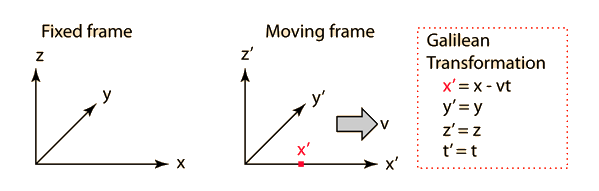
Here is the classic diagram used to explain the Galilean Transform:
galilean jpeg.jpg
galilean jpeg.jpg (11.68 KiB) Viewed 14400 times
The maroon and blue lines represent two coordinate systems. They are separating from each other at velocity V. The duration of time that has passed since O, the origin of the maroon coordinate system was aligned with O', the origin of the blue coordinate system; and the occurrence of the “event” is ambiguous, but the event appears to be associated with the blue (moving) coordinate system. At the start of the epoch, (when both origins were coincident) the “time” in both coordinate systems is 0 (zero).

The slight of hand here is that the “event” is only in one coordinate system or the other. It has to be, because an “event” implies duration. The duration of the event is not considered in the diagram. If it is, then in one coordinate system or the other, the event will have to be shown as a distance too: If the “event” started at the same instant that the epoch did (when both origins were coincident) assuming that the “event” is in the O' system, it must be shown as a line segment in the O system.

In other words: If the “event” started at x' in the O' system, (before the time that O' has moved the distance vt) the coordinates of the “event” in the O' system will remain at x' as time passes. However, the coordinates “transformed to the O system” will be a line segment the length of vt.

So, I wish to make two points here:

The passage of time does not make itself apparent in the O' coordinate system. This does not mean that time does not pass in the O' coordinate system. This is because the “event” is a fixed distance from the origin in this system. We just know it passes, even though there is no change in coordinates for the duration of the “event” in this system.

The “transformation to the O coordinate system” is not reversible, since the transformation actually turns the point in the O' coordinate system into a line segment in the O coordinate system.

.
I sense a disturbance in the farce.

Goldminer
Posts: 1024
Joined: Wed Jul 08, 2009 9:08 pm

Re: Silly Einstein

Unread post by Goldminer » Tue Nov 29, 2011 10:44 am

In regards to the "Galilean Transform:"

IMHO, nearly everyone is missing the fact that all observers in either frame must remain fixed in relation to the origin of their respective frame/system. Whereas the source may be placed anywhere in the source frame, there is less confusion, as a convenience, if it is placed at the origin of the source frame.

Next IMHO, nearly everyone is missing the fact that there are two entities that are undergoing motion in the "Galilean Transform." One is the expanding pulse wave of light (EMR). The other is the "moving coordinate system/reference frame." I pointed out in the post above, that the source is only in one frame or the other, and either frame may be taken as the "rest frame." In the discourse below, I am taking the source frame as the rest frame.

The expanding pulse wave of light (EMR) is generated by the source. There is only one source under investigation, and the pulse light wave expands away from it in all directions at the same speed. IMHO, this fact generates an expanding sphere with the source at the center. It is/must be depicted as existing in this form only in the source frame/coordinate system.

For emphasis: The source exists, fixed to the origin, only in the source frame/coordinate system. It cannot be both fixed in the source frame and fixed anywhere in the moving system. [except "instantaneously." Over many "instants," the source will become a series of points in the moving system, forming a line there. (As long as the moving system is moving in a straight line, unvarying in velocity.) ]

In reality, the only way the light/EMR sphere can be known is to be detected by sensors made of matter. I am naming these "sensors" observers. In the source system, they are fixed to the source's coordinate system origin. The observers in the moving system are at fixed distances from each other and the moving system origin. In the moving coordinate system each observer has fixed coordinates (x,y,z).

The source however, as depicted in the moving system, (moving along the X axis in the moving system) will have multiple X axis coordinates; one for each instant of time as time passes. So . . . the source coordinates as "transformed to the moving system" are (xt=0,y,z); (xt+1,y,z); (xt+2,y,z); (xt+successive instants of time,y,z): essentially forming a line in the moving system graph.

Therefore, moving system observers will encounter successive wave fronts of the expanding sphere at decreasing radii as they approach the source, and increasing radii wave fronts as they recede from the source. Meanwhile the source itself will appear to approach or recede from the moving observer. The source approaching or receding from the moving observer is what creates the line depiction of the source in the moving frame/system. (It is not seen in reality as a line, it is just seen as increasing or diminishing in size with change in distance from the observer.)

Concurrently in the source frame/system, each observer will encounter fixed radii wave fronts of the expanding sphere. The source appears unchanging in size for each observer in the source frame/system.

In the conventional "Galilean Transform,"
Image
Image
Image
Image

And the transform from the other frame/coordinate system back is x= (x'+vt)

In reality, the transform is non-reversible, their "event" is not defined, and the source is not "in" the opposite frame. If "x' " represents an observer, and (x-vt) represents that same observer in the other system at a particular instant, then, over a duration of time the (x+vt) will depict a line in the said system, just as the source does in that system. Of what use is that?

Logic tells me that the moving system has it's own observers fixed in relation to the moving system origin; likewise the source system has it's own observers fixed in relation to the source system origin. "x" and "x' " are separate entities; and in the moving frame/system, any one observer is both approaching/receding the source and being impinged by wave fronts that have traveled away from the source. The observers do not detect the source directly, they only detect the wave fronts.

Thus, the "transform" is non-reversible.

So . . . what exactly is the event which Einsteinians use as the basis of all their musings???

.
I sense a disturbance in the farce.
Goldminer
Posts: 1024
Joined: Wed Jul 08, 2009 9:08 pm

Re: Silly Einstein

Unread post by Goldminer » Sat Dec 03, 2011 12:30 pm

In sound transmission, the medium can have relative motion to both emitter and receiver. The motion of a sound producingn emitter to the medium creates a Doppler effect for a receiver at rest with the emitter, right?

"The total Doppler effect of sound may therefore result from motion of the source, motion of the observer, and/or motion of the medium."

In EMR, the medium is the aether. The aether apparently does not have the property of motion: the Doppler shift for light is not effected by motion of the aether. Therefore, the Doppler shift has nothing to do with transmission of the waves; only the relative motion between emission and the receiver.

Only receivers at rest with the emitter find no Doppler shift. This leads me to believe that the aether carries the disturbances in the aether caused by the source, along with the source; yet radiating from it (the source) at c, the speed of light; regardless of the source's motion to anything else.

In other words, light pulses radiate spherically away from an un-acelerated emitter, regardless of the supposed motion of the emitter and its radiation to the aether. All receivers located on a given radius sphere centered on the emitter will detect the pulse simultaneously.

Recent experiments are finding that the one way speed of light from moving sources is at variance with Einstein's suppositions.

(radar ranging of the planets, and laser pulses using GPS synchronized clocks.)
I sense a disturbance in the farce.

Goldminer
Posts: 1024
Joined: Wed Jul 08, 2009 9:08 pm

Re: Silly Einstein

Unread post by Goldminer » Fri Dec 23, 2011 11:39 pm

LUNAR LASER RANGING TEST OF THE INVARIANCE OF c
DANIEL Y. GEZARI wrote:"The most straightforward analysis and interpretation of two-way lunar laser ranging measurement of c presented here suggests that light propagating between the Earth and the Moon obeys a classical rather than special relativistic addition of velocities law.

On the face of it, this constitutes a first-order violation of local Lorentz invariance and implies that light propagates in an absolute reference frame, a conclusion that most physicists (except perhaps some contemporary field theorists) would be reluctant to accept. Rather than simply dismiss the present results and conclusions as implausible, which would be natural considering the strength of the prevailing view, it would be prudent to critically re-examine and improve the present experimental basis for special relativity in the photon sector.

Ultimately, any concerns about the validity of a theory can only be resolved by experiment. We are now pursuing two new approaches to one-way measurements of the speed of light with slowly moving sources and detectors, both by one-way laser ranging outside the Earth’s atmosphere (Gezari et al. 2010) and by direct optical pulse timing in the laboratory."
Just sayin' . . .
I sense a disturbance in the farce.

Goldminer
Posts: 1024
Joined: Wed Jul 08, 2009 9:08 pm

Re: Silly Einstein

Unread post by Goldminer » Sat Jan 21, 2012 8:21 am

Doppler shift only results when the distance is changing between source and observer. That's what "relativity" is all about. According to our hero A. E. there is no stationary and moving anything. Either the distance is not changing, in which case the source and observer are in the same "frame" or the distance is changing, in which case the source and observer are in different "frames."

If we consider only one source and it only emits one short powerful pulse of light, so that we can understand where in space this pulse has expanded at a given time and distance from whence it was emitted, we can easily understand that an observer that is at an unchanging distance from said source will detect the pulse un-Doppler-shifted at said time and distance.

Now, let's take this above said "stationary" observer and use it for the point in time and space under consideration. (This is the time and place where the wave front reaches this observer.): Next let's consider two additional observers, one approaching the above said time and distance from the source from the opposite direction of the expanding wave front, and one approaching the above said time and distance from the source in the same direction as the expanding wave front.

Both of these observers reach said point at the exact same time as the above said "stationary" observer.

What facts can we extrapolate from this situation?

1. There is no problem with simultaneity: all three observers detect the same wave pulse at the same time and place in space.

2. Each of the three observers detects a different version of the pulse:

a. The observer at an unchanging distance detects an un-Doppler-shifted pulse of light.

b. The decreasing distance observer detects a "blue" shift.

c. The increasing distance observer detects a "red" shift.

Duh. No Minkowski or time space continuum, no clock problem, no shortened distance between frames problem!
I sense a disturbance in the farce.

Goldminer
Posts: 1024
Joined: Wed Jul 08, 2009 9:08 pm

Re: Silly Einstein

Unread post by Goldminer » Sun Jan 22, 2012 7:41 pm

So, why do our Einsteinian relativists think there is a problem with simultaneity between frames?

That's the question of the last 100 years! IMHO, the problem arises due to their wanting something interesting to arise from something mundane. In their haste to form a mathematical description, they have not described the problem.

All of their math depends upon the "transform" that they call the "Galilean" transform. This is the Granddaddy to everything mathematical in the theory of relativity. It is diagrammed thus:

Image

Diagram found here

Please note that they describe a "point x" that is being "transformed" into another coordinate system and becomes x'.

So, what does "point x" represent? As best as I can figure out it represents a source of a pulse of light. Anyone have a better/different explanation? None of the explanations I have come across have defined what "x" represents, other than that it is an "event."

Now, from what I learned in high school algebra, one must carefully define one's terms, so as not to become confused during the construction/formulation of the problem.

Einsteinians get as far as this/these diagrams and then begin with their math. Wonderful!

Please allow me to point out that this point/event x is apparently the source of a pulse of light. The real problem is not transforming the point of light source from one frame to another. The real problem is that at any given distance from the source/point, there is a delay over said distance before the pulse is detected. Almost everyone understands this fact, and yet their diagrams ignore it.

So, Mr. brilliant Goldminer, how would you diagram said situation?

I'm glad you asked!

Remember, the real problem is: What is the distance and time delay of a pulse of light as it expands from the source?
I sense a disturbance in the farce.

Goldminer
Posts: 1024
Joined: Wed Jul 08, 2009 9:08 pm

Re: Silly Einstein

Unread post by Goldminer » Sat Jan 28, 2012 1:18 am

Goldminer >>Sat Jan 21, 2012 8:21 am wrote:Doppler shift only results when the distance is changing between source and observer. That's what "relativity" is all about. According to our hero A. E. there is no stationary and moving anything. Either the distance is not changing, in which case the source and observer are in the same "frame" or the distance is changing, in which case the source and observer are in different "frames."

If we consider only one source and it only emits one short powerful pulse of light, so that we can understand where in space this pulse has expanded at a given time and distance from whence it was emitted, we can easily understand that an observer that is at an unchanging distance from said source will detect the pulse un-Doppler-shifted at said time and distance.

Now, let's take this above said "stationary" observer and use it for the point in time and space under consideration. (This is the time and place where the wave front reaches this observer.): Next let's consider two additional observers, one approaching the above said time and distance from the source from the opposite direction of the expanding wave front, and one approaching the above said time and distance from the source in the same direction as the expanding wave front.

Both of these observers reach said point at the exact same time as the above said "stationary" observer.
What facts can we extrapolate from this situation?

1. There is no problem with simultaneity: all three observers detect the same wave pulse at the same time and place in space.

2. Each of the three observers detects a different version of the pulse:

a. The observer at an unchanging distance detects an un-Doppler-shifted pulse of light.

b. The decreasing distance observer detects a "blue" shift.

c. The increasing distance observer detects a "red" shift.

Duh. No Minkowski or time space continuum, no clock problem, no shortened distance between frames problem!
This quote is from Sat Jan 21, 2012 8:21 am, several posts back. I need to change the highlighted sentence to read:

"Both of these observers reach said point at the exact same time as the above said expanding wave front meets the "stationary" observer." The point being that all four entities meet at the same time and place. This is the absolute definition of simultaneity!

Obviously the three observers must be a little off in their aim, otherwise there will be a collision here! Since there is only one pulse of light, this is the only time these three entities will ever see the pulse. No future, no past; only the one instant. Where do the Einsteinians get off with their "past and future light cone?"
I sense a disturbance in the farce.

User avatar
webolife
Posts: 2539
Joined: Mon Mar 17, 2008 2:01 pm
Location: Seattle

Re: Silly Einstein

Unread post by webolife » Mon Jan 30, 2012 1:16 pm

I've posted the following simple kitchen experiment on a couple of other threads over the past few years:

Tie a length of string to the full chamber of an hourglass egg timer.
Whirl it around rapidly until the chamber is empty.
The egg is not cooked, nor is Einstein's time dilation.

Orbital acceleration under relatively constant centropic force, changes the timing of the clock, in this case speeding it up, in utter contradiction of the twins paradox.

Acceleration, pressure, not velocity.
Truth extends beyond the border of self-limiting science. Free discourse among opposing viewpoints draws the open-minded away from the darkness of inevitable bias and nearer to the light of universal reality.

Goldminer
Posts: 1024
Joined: Wed Jul 08, 2009 9:08 pm

Re: Silly Einstein

Unread post by Goldminer » Mon Jan 30, 2012 11:28 pm

webolife wrote:I've posted the following simple kitchen experiment on a couple of other threads over the past few years:

Tie a length of string to the full chamber of an hourglass egg timer.
Whirl it around rapidly until the chamber is empty.
The egg is not cooked, nor is Einstein's time dilation.

Orbital acceleration under relatively constant centropic force, changes the timing of the clock, in this case speeding it up, in utter contradiction of the twins paradox.

Acceleration, pressure, not velocity.
Have you defined "centropic" somewhere? There is the big argument between centrifugal and centripetal force, do ya mean something along those lines?

I haven't spent a lot of effort on the subject of "time" in this Silly Einstein thread since I regard Einstein's pursuit of the subject as a rabbit hole. Your hour glass example does indeed depend upon either gravity or inertial acceleration to "mark" time! Astronauts could surely spend forever in space if they relied upon this! Does time stop just because you didn't wind your wristwatch? Do ya even know what a windup watch is?

OK, stand back, my clock juices are roiling up!

Start here

Two aspects of measuring time seem to get confused. The setting of a clock to the current time gets confused with the regulation of the clock. When one sets a clock, what is set is the number of cycles that have elapsed since the beginning of an epoch. This is accomplished by setting all the clocks to zero at a particular instant or all to a particular number of counts at an instant.

The second is known as regulation. All the clocks must count the same number of cycles in a given duration of time. I know, circular definition. (your hourglass is in a category all its own.)

Back to Station WWV, or any time reference source. The signals they all send out are subject to the signal latency. This latency is mainly due to the distance the signal travels. To remove this distortion, a two way communication is required, to measure the delay and report it to the receiver. (it is subtracted out to make the receiver clock read the same time as the transmitter clock, at the same time in different places.) If the distance is changing between the two clocks; slave and master, you can see the problem of subtracting out the latency.

The above paragraph points out some of the problems with setting a remote clock to the right time. The next point is that the Doppler effect changes the frequency of the master clock as received by the slave. This factor is essentially changing the regulation of the master clock as the slave clock-in-motion receives it. Consequently, the approaching slave clock finds the master clock running fast, and the receding slave clock finds the master clock running slow.

So, you see the constant velocity of a clock relative some other clock causes problems regulating and setting the one to the other, but nothing to do with actual passage of time with respect to either.

A pendulum clock is regulated by the length of the pendulum and the sprung balance wheel clock is regulated by the tension on the spring, neither of which depend directly upon the acceleration of gravity in their vicinity. Same with a quartz clock. Your hourglass, however certainly does.

In the Einstein universe each clock runs faster that the other one, and when more clocks moving a various velocities in various directions are added to the scene, each one runs faster than all the rest! Isn't that just democratic?
I sense a disturbance in the farce.

User avatar
webolife
Posts: 2539
Joined: Mon Mar 17, 2008 2:01 pm
Location: Seattle

Re: Silly Einstein

Unread post by webolife » Fri Feb 03, 2012 8:12 pm

Many time paradoxes indeed!!!
The hourglass is designated by Einstein as a clock that would be subject to time dilation in the Twins Paradox.
This is why I brought it up here, and elsewhere. Your pendulum length, however is indeed subject to and dependent upon the local gravity field. The vibrations of the quartz watch mechanism are dependent on a more atomic sized "gravitational" field -- clearly electric in the latter case, probably electrogravitic in the former.

Since all motion in the universe is subject to "gravitation" to a local center [definition of "centropic" force/pressure] the swinging egg-timer serves to illustrate a fact overlooked in the general explanation of the "Twins". Not only does the astronaut Twin need to speed rapidly [at c] away from his earth-bound brother, he needs to keep moving at the same rate while beingturned back homeward to complete his journey and be found "forever young"... the forces required to accelerate the spacey twin are of course impossibly huge, like the physical time discrepancy, and beyond any hope of actual measurement. The circuitous trip requires a huge energy input, and ignores the fact that all motions are actually n-body problems. Even the small amount of energy expended in swinging the egg-timer, results in the moving clock time running faster than the clock on the wall...

...and yet the story is always told as if the time dilation WOULD HAPPEN if a person could travel at the c-rate, and "silly everyone" just accepts that somehow this is physics.
Truth extends beyond the border of self-limiting science. Free discourse among opposing viewpoints draws the open-minded away from the darkness of inevitable bias and nearer to the light of universal reality.

Goldminer
Posts: 1024
Joined: Wed Jul 08, 2009 9:08 pm

Re: Silly Einstein

Unread post by Goldminer » Fri Feb 03, 2012 10:51 pm

webolife wrote:Many time paradoxes indeed!!!
Your pendulum length, however is indeed subject to and dependent upon the local gravity field.
Yes, a bit of fuzzy thinking there on the old miner's part. What I had in mind was that the pendulum is not regulated by adding weight to the bob of the pendulum, it is regulated by changing the distance from the bob to the fulcrum. I jumped from there to concluding that increased gravitational acceleration increases weight. The two are not interchangeable. Adding weight does not increase the acceleration. Objects of different weights all accelerate to the same speed in the same given time.

Unless spinning!
DePalma wrote:The result was a striking "stroboscopic, time-lapse photograph" of the parabolic arc of both steel balls -- flying upward and then downward under Earth's gravitational acceleration (below).
Image
Looked at even casually, one can instantly see in the resulting time-lapse image (above) that the two pinballs did NOT fly along identical parabolic arcs (as they should have); unmistakably, the steel ball that was rotating (at ~27,000 rpm) flew higher ... and fell faster ... than the companion ball that was not rotating!
An experimental result in direct violation of everything physicists have thought they've known about both Newton's Laws and Einstein's Relativity ... for almost (in the case of Newton ...) three full centuries!
Tbolt thread on Torsion Field vs EM Field vs Free Energy

Also this site about half way down the page

.
I sense a disturbance in the farce.

Locked

Who is online

Users browsing this forum: No registered users and 10 guests