Does this need correction?
---------------------------------
After all that, we may be pretty sure that spin is not what caused the Explorer Anomaly. So we still have an experimental failure of about 33%. As I hinted above, the first thing we should have looked at is the E/M field. But, as I have shown in a series of other papers, even the E/M field is not strong enough to cause such a large gap. I have shown that the E/M field of the Earth is .009545m/s2, negative to gravity, which would cause a .1% change in g. But this change would not be apparent in any equations at NASA, since they are and always have been measuring a compound field. 9.81 is the correct value for this compound field, so their ignorance about its make-up cannot be a factor.
No unknown perturbations or tidal forces from the Moon can have caused a 33% failure either, since we would have seen these forces in other experiments. A directional perturbation like this must have caused predictable or post-dictable changes in the shape of the expected orbit as well, and this is not what we find. We do not find the rockets pushed toward or away from the Moon.
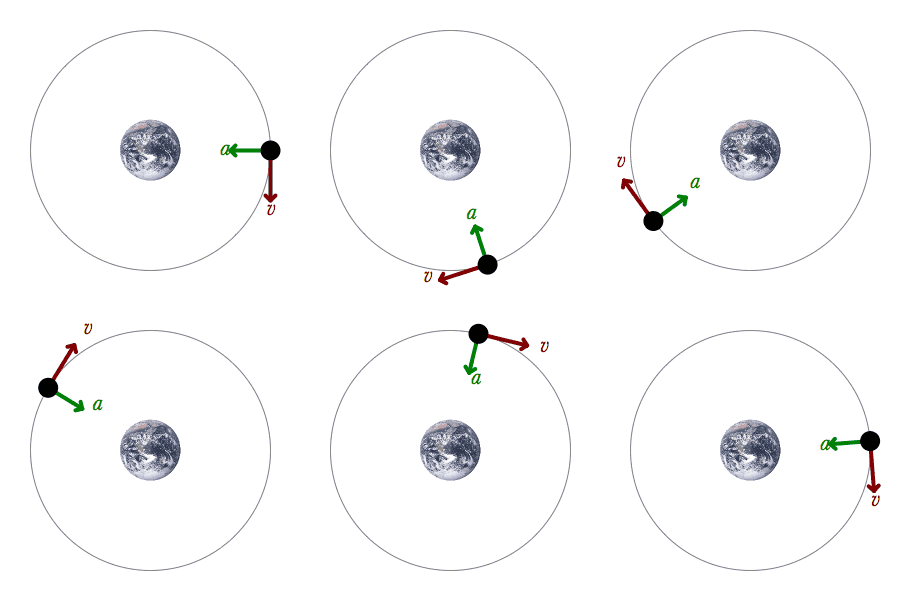
So what could cause such a large failure in such a simple experiment? We have to look at the math to tell. Although the rocket flew over 1/3 higher at apogee, the math shows "almost a 20% error", according to Hoagland1. I have scanned his math, and he appears to be right. The error in the Explorer propulsion equations is 19%. The orbital equation currently used is a=v2/r, where v = 2πr/t. Solving using the current value for π gives us a=39.5r/t2. Using my correction to π as well as my correction to the equation a=v2/r,* we get a=32r/t2. The difference between 39.5 and 32 is 19%. We have a match.
A close reader will say, "According to your theory, the circumference is 4 times the diameter in a kinematic situation. That means that any curve—including an orbit—must be larger than we previously thought. Shouldn't the rocket miss short and not long?" No, 32 is less than 39.5, so the acceleration in my correction is less than the acceleration in the old equations. That is, the centripetal acceleration is less than the engineers thought at the time, therefore the rocket must fly higher. This is not to say that the current value of 9.8 is wrong, it is just to say that relationship of 9.8 to the other numbers like radius and velocity and time was wrong.
http://milesmathis.com/pi4.htmlOn the Windhexe: ''An engineer could not have invented this,'' Winsness says. ''As an engineer, you don't try anything that's theoretically impossible.''



 :
: