| |
[ top ] |
Comets: Deep Impact |
Crater size Thornhill: The impact/electrical discharge will be into rock, not loosely consolidated ice and dust. The impact crater will be smaller than expected.
see [ 2005 July 03] | Result The occlusion of the impact site by the unexpected dust cloud leaves this question of crater size unanswered. (Some NASA investigators have suggested that the impact did not reach a deep level, but so far the pronouncements on the subject are quite contradictory because they're trying to explain things they did not expect).
see [ 2005 July 19] |
| |
Changes to jets Thornhill: Changes to the appearance of the jets may be seen before impact.
see [ 2001 Oct 18] | Result Failed electronics prevented any details from being seen before impact. See previous observation.
see [ 2005 July 08] |
| |
Arcs will be hotter than expected Thornhill: Any arcs generated will be hotter than can be explained by mechanical impact. If temperature measurements are made with sufficient resolution, they will be much higher than expected from impact heating.
see [ 2005 July 03] | Result Though we've found nothing from NASA relating to the temperatures of the explosion, we said that the discharge would be "hotter than can be explained by mechanical impact. If temperature measurements are made with sufficient resolution, they will be much higher than expected from impact heating". On this one we are confident as ever.
see [ 2005 July 08] |
| |
High-energy electrical noise Thornhill: The signature of an electrical discharge would be a high-energy burst of electrical noise across a wide spectrum, a "flash" from infra-red to ultraviolet and the enhanced emission of x-rays from the vicinity of the projectile. The energy of a mechanical impact is not sufficient to generate x-rays.
see [ 2001 Oct 18] | Result So far there has been no indication that any instrument based near or on Earth had the temporal or spatial resolution to decide this issue.
see [ 2005 July 19] |
| |
Copious X-rays Thornhill: X-rays will accompany discharges to the projectile, which will not match X-ray production through the mechanics of impact. The intensity curve will be that of a lightning bolt (sudden onset, exponential decline) and may well include more than one peak.
see [ 2005 July 03] | Result So far there has been no indication that any instrument based near or on Earth had the temporal or spatial resolution to decide this issue.
see [ 2005 July 19] |
| |
Speed of transport Electrical theorists suggest that NASA carefully review the rate at which ejecta filled the coma. Could kinetic effects (the effects of physical impact alone) have generated such speeds? Acceleration of negatively charged material is a predictable effect of electric discharge.
see [ 2005 July 04] | Result See previous observation. |
| |
Ionized copper Thornhill: Copper atoms ionized to a surprisingly high degree should be detectable from Earth-based telescopes.
see [ 2001 Oct 18] | Result See previous observation. |
| |
Heavy elements Thornhill: If an arc is struck between the comet nucleus and the projectile, we may expect to see metals such as Li, Na, K, Ca, Mg and Fe in a flash spectrum before impact. They will have been removed from the rocky comet in the cathode arc.
see [ 2005 July 03] | Result See previous observation. |
| |
Negative ions Thornhill: NASA investigators should look for an abundance of negative ions in the impact ejecta. This would be an obvious signature of a negatively charged comet. Forbidden spectral lines from negative oxygen ions have been detected spectroscopically in comet comas in the past. They indicate the presence there of a strong electric field.
see [ 2005 July 03] | Result See previous observation. |
| |
[ top ] |
Sun |
Brightness of ENA's Thornhill: The solar cycle is controlled by its local galactic Z-pinch, so any variation in ENA’s may provide some clues about the origin of the quasi-cyclic variability in the circuit supplying DC electrical power to the Sun or “solar cycle.” The “brightness” of the ENA’s should vary, probably out of phase with the solar cycle.
see [ 2009 Oct 20] | Result Awaiting confirmation |
| |
Moving bright spots Thornhill: Given the detail in this model we should expect, as more data comes in, that researchers may find in the ENA “ribbon,” bright spots, filamentary structures, and movement of the bright spots consistent with rotation of Birkeland current filament pairs and their possible coalescence.
see [ 2009 Oct 20] | Result Awaiting confirmation |
| |
Direction of cosmic rays Thornhill: If the diagram above is close to the real situation then we might expect cosmic-ray electrons to arrive from the double layer in the opposite direction in the sky to the nuclear cosmic rays.
see [ 2009 Oct 20] | Result Awaiting confirmation |
| |
Shape of Sun's galactic plasma environment Thornhill: The EU model confidently predicts that the shape of the Sun’s galactic plasma environment is the hourglass, Z-pinch shape of planetary nebulae and supernovae, aligned with the local interstellar magnetic field.
see [ 2009 Oct 20] | Result Awaiting confirmation |
| |
[ top ] |
Mercury |
Surface composition Thornhill: Mercury does not conceal a metal heart larger than that of Mars. It will be found eventually to have a composition and structure like that of similar looking bodies in the solar system. Analysis of Mercury’s surface mineralogy will validate that superficially at least
see [ 2008 Jan 14] | Result Awaiting confirmation |
| |
Electrical scars Thornhill: The surface of Mercury should exhibit global electrical scarring features.... Cosmic discharges take the form of rotating pairs of Birkeland filaments, which drill into a surface to form rotary and corkscrew patterns. Corkscrew walled craters are found on the Moon. In many craters the rotating Birkeland filaments may leave a central peak untouched. Changing discharge current may generate corkscrew patterns and pulsations in the current or cylindrical particle beams create concentric configurations.
see [ 2008 Jan 14] | Result Awaiting confirmation |
| |
Weak dipolar magnetic field Thornhill: Mercury is likely to have a weak dipolar magnetic field.
see [ 2008 Jan 14] | Result Awaiting confirmation |
| |
Surface appearance Thornhill: In the near vacuum at Mercury’s surface, electrons will strike the surface and form more dense plasma. If sufficiently dense, the plasma layer acts like a metallic surface coating and returns a strong radar echo. I have addressed this issue in the “The Shiny Mountains Of Venus.” [ 2008 Jan 14] | Result Awaiting confirmation |
| |
[ top ] |
Moon |
Craters and rilles On September 14, 2007, the Japan Aerospace Exploration Agency (JAXA) launched the Selenological and Engineering Explorer (SELENE) on a multi-year lunar orbit mission. In the next few months, we predict that new images and telemetry will help to confirm the theories of an early EU proponent, Ralph Juergens, who has lent inspiration to new generations of investigators.
see [ 2007 November 21] | Result Awaiting confirmation. |
| |
[ top ] |
Mars |
Sulfurous smell Stephen Smith: A sulfurous smell is sometimes reported after thunderstorms have passed. The lightning bolts are strong enough, apparently, to change some of the oxygen in the atmosphere into sulfur that burns to become sulfur dioxide, a strong-smelling compound. After an "electric dust devil" passes by on Mars that same stench could be present. If our theory of gigantic electric arcs large enough to carve Valles Marineris is correct, a great deal of sulfur may have also been created in that cataclysm and spread around the planet.
see [ 2007 November 16] | Result Awaiting confirmation. |
| |
No evidence of flowing liquid When viewed more closely no evidence of flowing liquid will be found.
see [ 2007 May 14] | Result Awaiting sufficient data. |
| |
[ top ] |
Saturn |
Shape of hot pole Thornhill: Returning to Saturn's polar very hot "tip", it should be found on closer inspection to exhibit a similar structure to the Venusian polar dipole. Its compactness is due to the electromagnetic pinch effect where it enters Saturn's atmosphere.
see [ 2005 February 5] | Result Unknown |
| |
Variable hot pole Thornhill: The hot spot's behavior should be variable like that on Venus and correlated with the appearance of Saturn's ring spokes, which are a visible manifestation of a heightened equatorial discharge in that part of Saturn's Faraday motor circuit.
see [ 2005 February 5] | Result Unknown |
| |
[ top ] |
Saturn's moons |
Melted craters and rilles Telesto, Calypso and Pandora may not have had their craters and rilles softened by a layer of dust. Their craters and rilles may have been literally softened by melting. Radar measurements should be able to distinguish between the two.
see [ 2007 May 15] | Result Awaiting sufficient data. |
| |
Galvanic coupling In a June 13, 2007 European Space Agency release it was announced that two other moons of Saturn, Tethys and Dione, are “flinging great streams of particles into space.” The Cassini Plasma Spectrometer (CAPS) made the discovery when data from Saturn revealed that a torus of charged particles surrounds the planet, trapped within its magnetic field. So far, three moons have demonstrated connections with a vast electric field that links them to Saturn. We predict that other moons within the Saturnian system will reveal similar galvanic coupling as more data is received.
see [ 2008 Feb 25] | Result Awaiting sufficient data. |
| |
Cassini safe passage Cassini has been in orbit around Saturn since July 1, 2004. As it made its way into the electrically active environment of the monstrous gas giant it slowly equalized its charge potential with that of Saturn and its surroundings. It can be expected that it is now at equilibrium with the ionized potential of the system so there should be no arcing between the spacecraft and Enceladus as it passes through the rarified vapor that is being drawn upward from the moon’s fractured pole. There is the remote possibility that Cassini will make contact with a Birkeland current filament that is excavating material out of the moon, but the coincidence would be surprising. For all intents and purposes, there will be no effect on Cassini when it encounters Enceladus at its closest approach.
see [ 2008 Feb 25] | Result Awaiting sufficient data. |
| |
Copious ice or water Thornhill: So we should not be surprised if, under the orange haze, that Titan has copious ice or water.
see [ 2004 Jun 19] | Result Awaiting confirmation. |
| |
Polar warm spots Thornhill: So it would not be surprising if Titan had warm spots over the poles, like Venus.
see [ 2004 Nov 25] | Result Awaiting confirmation. |
| |
Atmospheric components Thornhill: And just as Mars has a whiff of the Venusian atmosphere, with carbon dioxide and nitrogen as major constituents, we may expect to find that the Titan atmosphere has some of the smell of Venus about it.
see [ 2004 Nov 25] | Result Awaiting confirmation. |
| |
Non-uniform cross-sectional area Thornhill: Rivers maintain a constant cross-sectional area between feeder channels. Lightning has no such constraint and may, depending on the electrical nature of the surface, carve a deep V-shaped channel or skim across the surface leaving almost no trace. The renowned Hadley’s Rille on the Moon, visited by astronauts, shows this characteristic. It may require a Titan orbiter, though, before this kind of detail is available.
see [ 2005 Jan 21] | Result Awaiting confirmation. |
| |
[ top ] |
Europa |
Ice cracks Thornhill: Europa receives a lot of attention because it is thought to have an ocean that might harbour life hidden under the icy surface. But if geologists' cracked ice models are so wide of the mark then they may be disappointed. On the other hand, the electrical model suggests a far more interesting history of the solar system than textbooks allow!
see [ 1999 October 21] | Result Awaiting sufficient data. |
| |
[ top ] |
Asteroid: Vesta |
Circular crater Thornhill: I predict that the crater on Vesta, when photographed more closely, will be circular also.
see [ 1997 November 3] | Result Unknown |
| |
[ top ] |
Supernovae: SN1987A |
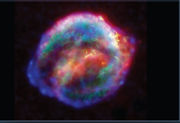
Axial rings Thornhill, in a recent IEEE paper suggested (following Alfvén's prediction of double layers occurring above the Sun's poles) that the two smaller axial rings of Supernova 1987a are actually glowing double layer phenomena. In other words, supernovae are a catastrophic stellar electrical discharge. A hallmark of double layers is their variability, or flickering, which would match the observation that "isolated points of x-ray emission have also been seen within the cloud that rise in intensity and then fade away rather quickly."
see [ 2007 November 15] | Result Awaiting confirmation. |
| |
[ top ] |
ULXs |
ULXs Mel Acheson: It’s likely that most ULXs will turn out to be quasars that have been generated recently by the host galaxy.
see [ 2008 January 3] | Result Awaiting confirmation |
| |
[ top ] |
Tunguska |
Increased density The researchers will return to Tunguska this summer with plans to drill beneath the bottom of Lake Cheko, hoping to find a meteorite. From an Electric Universe perspective, if the Tunguska explosion was the result of an electric discharge, a meteor fragment may indeed be found, pointing to the source of the discharge. But more likely, the increased density beneath the lake could be the signature of the electric arc that excavated the depression, producing the fused sands and soils of a fulgurite.
see [ 2007 July 05] | Result Awaiting confirmation. |
| |