|
Twinkle, twinkle electric star
07/01/08
Twinkle, twinkle electric star
Astronomers don’t know what you are!
Sit down before facts like a child, and be prepared to give up
every preconceived notion, follow humbly wherever and to whatever
abysses Nature leads, or you shall learn nothing.
— T.H. Huxley
An undergraduate textbook on the structure and evolution of stars
makes a star seem a simple thing: "A star can be defined
as a body that satisfies two conditions: (a) it is bound by
self-gravity; (b) it radiates energy supplied by an internal source.
" Buried in this definition are some critical assumptions
that Sir Arthur Eddington bequeathed to us long before the space
age in his 1926 opus, The Internal Constitution of the Stars.
But how many students now read his original work with a
critical eye?
Eddington wrote, "The problem of the source of a star’s
energy will be considered; by a process of exhaustion we are
driven to conclude that the only possible source of a star’s
energy is subatomic; yet it must be confessed that the hypothesis
shows little disposition to accommodate itself to the detailed
requirements of observation, and a critic might count up a large
number of ‘fatal’ objections. "
A single fatal objection would suffice to falsify the hypothesis,
but the apparent isolation of stars in the vacuum of space
encouraged the belief that stars must consume themselves to fuel
their fire. The fatal objections would be sorted out later. Two
such objections are behind NASA’s plan to launch a
mission to the Sun in 2015. That will be 89 years of denial
that there is a serious problem with our understanding of the
nearest star — the Sun!
Eddington argued the need for a central fire as follows, "
No source of energy is of any avail unless it liberates energy in
the deep interior of the star. It is not enough to provide for the
external radiation of the star. We must provide for the maintenance
of the high internal temperature, without which the star would
collapse. " But this assumes that a star is basically a
ball of hot gas, obeying the standard laboratory gas laws.
Eddington’s ‘logic of exhaustion’ had to set aside facts that
didn’t fit the "only possible" theory.
Appearances can be deceptive when viewed through the lens of a single
idea. A kind of tunnel vision develops that accommodates ‘fatal
objections’ with the excuse that "someday we will find the
answers." To compensate for the weakness of the excuse, those
who adopt the consensus view acquire a kind of evangelical zeal. As
exhibit, the undergraduate textbook referred to above opens with:
"The theory of stellar structure and evolution is elegant
and impressively powerful. " Yet we have recently discovered
a star that "shouldn’t exist" because it is too big to be
inflated by a central fire.
The tunnel vision does more than magnify the elegance of the single
idea. It also excludes considering other ideas. Alternative ideas
are stymied by unquestioning faith in the "only possible"
theory. For this reason, as history shows, most fundamental
breakthroughs come from outsiders — those who "sit down before
facts like a child."
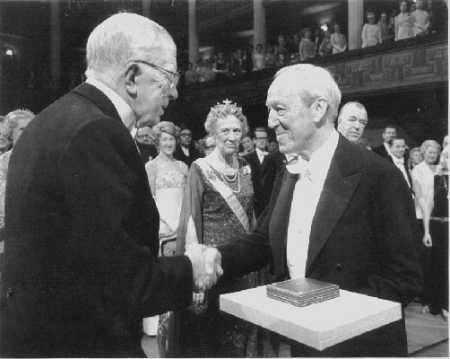
[Click on image to enlarge]
One such outsider had already published an electrical theory
of the Sun in 1913, long before Eddington’s work on the subject.
Kristian Birkeland (above left) was a renowned Norwegian
scientist and Nobel Prize nominee who set up observatories in
the Arctic Circle to study the Aurora Borealis. His story can be
read in Lucy Jago’s biography, The Northern Lights. His
theory that the aurora is due to ‘charged particle beams’ from
the Sun has only recently been confirmed. Birkeland’s approach
was largely experimental. He managed to reproduce sunspot behavior
(inset) in his famous Terrella experiments where he applied
external electrical power to a magnetized globe
suspended in a near vacuum.
Another outsider was Charles E. R. Bruce. He was a fellow of
the Royal Astronomical Society (1942), the Institute of Physics
(1964), the Institution of Electrical Engineers (1965), and was
a member of the Electrical Research Association (ERA) from 1924
until his retirement in 1967. His interest in astronomy and
study of lightning led him to write in 1968, "The main
observational evidence indicating the existence of cosmic
electrical discharges is the same as that which would lead an
external observer to conclude that lightning flashes occur in
our own atmosphere — namely, the sudden change they effect in
the spectra of the Sun, stars and galaxies. In the Sun’s
spectrum, lines suddenly appear indicating the existence of gas
temperatures of hundreds of thousands or even millions of degrees.
" Electric Fields in Space, Penguin Science
Survey 1968, p. 173.
An important outsider was the late Ralph E. Juergens, an engineer
and a pioneer of the electrical model of stars who was inspired
by Bruce. Because of the tunnel vision of the consensus view, he
was forced to publish his ideas in obscure journals in the early
1970s. His model is a shining example of commonsense and simplicity
when compared with the infernally complex and improbable
thermonuclear paradigm. Yet such is the inertia of institutionalized
science and its hostility toward interlopers that Juergens’ insight
was in danger of being lost following his untimely death in 1979.
"As I pursued the phenomenology of electric discharges, it
gradually dawned on me that, structurally, the atmosphere of the
sun bears a striking resemblance to the low-pressure type of electric
discharge known as the glow discharge… " — Ralph E. Juergens.
The insiders’ unquestioned assumptions blindfolded them to other
possibilities. Sydney Chapman commented in The Solar Wind,
"It seems appropriate to call attention to the ideas, put
forward over many years by Bruce, concerning the importance of
electrical discharges in the cosmos, and in particular in the Sun’s
atmosphere. Bruce agrees that the Sun offers his ideas perhaps their
greatest challenge, because of the very high electrical conductivity
of the solar material at all levels. Any electrical discharge in the
Sun’s atmosphere demands an exceptionally rapid and strong means of
generating differences in electric potential. " Here we see
a recognized leader in the field assuming that the Sun itself, as an
isolated body in space, could somehow generate its own electricity.
Eddington had addressed this problem of generating electricity when
trying to explain bright lines in the spectra of some stars. The
difficulty is that the heat of the star cannot supply the energy
of the atoms producing the bright lines. Something extra is adding
energy. He came close to the answer when he wrote, "If
there is no other way out we may have to suppose that bright line
spectra in the stars are produced by electric discharges similar
to those producing bright line spectra in a vacuum tube. "
He explains, "a disturbed (cyclonic) state of the atmosphere
might establish local and temporary electric fields—thunderstorms—under
which the electrons would acquire high speeds. " Collisions
between the high-speed electrons and atoms in the stellar atmosphere
would give rise to the bright spectral lines.
However, in a footnote Eddington reveals the fundamental limitation
of his theory of stars: "The difficulty is to
account for the escape of positively charged particles; unless
charges of both signs are leaving the escape is immediately stopped
by an electrostatic field. " This statement will
reverberate down the years as one of the gravest mistakes in science.
It is an ELECTROSTATIC model of an isolated, self-contained star.
But stellar magnetism is an ELECTRODYNAMIC phenomenon, requiring
electric currents flowing in circuits beyond the star.
Lightning and electrical discharges are a form of plasma and
research into plasma was going on while astrophysicists were
developing their one idea about stars. But their tunnel vision
kept them from becoming aware of it. When they did notice,
they only took in a flawed, incomplete form known as
‘magnetohydrodynamics,’ which, as the name implies, treats
plasma as a magnetized fluid. Their training does not give
astrophysicists the authority to judge an electric discharge
theory of stars.
Nowhere will you find any reference to electric discharge in
cosmology. The subject is not taught in astrophysics. Research
into plasma discharge phenomena is the domain of the largest
professional organization in the world, the Institute for
Electrical and Electronic Engineers (IEEE). My paper on electric
stars was published in the IEEE Transactions on Plasma Science,
Special Issue on Space and Cosmic Plasma in August 2007. The
IEEE recognizes and supports plasma cosmology. Electric stars
fit seamlessly with plasma cosmology and
electric galaxies.
Electric Stars
PLASMA COSMOLOGY
Almost all the matter in space is in the form of plasma. Clouds
of gas and dust contain free charged particles — ions, electrons
and charged dust (molecules). These charged particles respond
strongly to electric and magnetic fields. In cosmic molecular
clouds, where stars are formed, just one charged particle in ten
thousand neutral particles is sufficient for electric and
magnetic forces to overcome gravity.
Plasma in space is an excellent conductor but it is not
a superconductor, as astronomers assume when they talk of ‘frozen
in’ magnetic fields. Plasma clouds that move relative to each
other generate electric currents in each other. Electric currents
in plasma take the form of twisted filament pairs, which follow
the ambient magnetic field direction. The filamentary current is
electrically insulated from the surroundings in a way similar to
a current in an electric cable located in the ocean and carrying
current through a low resistance metal wire. The magnetic fields
generated by these currents have been detected between and within
galaxies. These currents are not visible because the current
density is too low to excite the plasma to emit light: The current
is in what plasma physicists call "dark current mode."
For currents to continue to flow, they must eventually form into
circuits. These invisible circuits are of crucial importance in
understanding the cosmos. If external electrical currents power
stars and galaxies, the power source is probably not located in
the stars. The situation is similar to viewing from space the
twinkling lights of great cities on Earth, which give no indication
of where the power is being generated.
Charged bodies embedded in plasma create about themselves a
protective cocoon of plasma, rather like a living cell wall. This
cell wall is known as a Langmuir plasma sheath, or ‘double layer,’
which contains most of the voltage difference between the charged
body and the surrounding plasma. Only an electric current sustains
the charge separation across the double layer. If the surrounding
plasma is moving relative to the charged body, the plasma sheath
is drawn out into a teardrop or cometary shape. And if the charged
body is rotating it will generate a magnetic field that is trapped
inside the plasma sheath. This has led to the misnomer —
"magnetosphere" — when referring to a plasma sheath.
The father of plasma cosmology, Hannes Alfvén, expressed the
opinion that double layers should be classed as "a new type of
celestial object." They are responsible for the radio noise
from ‘radio’ galaxies. In interstellar space they produce the cosmic
microwave radiation, mistakenly interpreted as the afterglow from
the mythical big bang. Alfvén tentatively suggested that
X-ray and gamma ray bursts may be due to exploding double layers.
An important feature of plasma sheaths, or double layers, is that
the electric field on either side of the thin double layer is very
weak and the plasma there is ‘quasi neutral.’ That’s why we do not
see evidence of a strong electric field from the charged Sun, and
why the ‘solar wind’ appears to be electrically neutral. For this
reason, the bulk movement and magnetic field of the ‘solar wind’
best signify the Sun’s electrical activity.
"So far as the solar wind is concerned, it is essentially
a dynamical phenomenon, which does not resemble, in any way, what
one would expect when treating stellar structure. " —
J. C. Pecker —Solar Interior and Atmosphere.
The so-called ‘winds’ and ‘jets’ of stars are a form of ‘dark
current,’ equivalent to the breeze from an air ionizer. The enigma
of prodigious stellar winds accelerating away from the ‘cool’
photospheres of red giant stars is simply solved [see later].
STAR FORMATION
Note: American Scientist explains, "the making of a star
is directed by a maelstrom of competing forces—including
gravitational collapse, magnetic fields, nuclear processes,
thermal pressures and fierce stellar winds—all of which wish to
have their way with the unformed star. Because the interaction
of these forces is not fully understood, there is much
that remains mysterious about the birth of a star.
" Precisely! The mysteries persist after more than a century
because the standard model of stars is utterly wrong.
An electric star is formed by the equivalent of a lightning bolt
in a molecular (plasma) cloud. Just like earthly lightning, cosmic
lightning scavenges, squeezes and heats matter along the discharge
channel. Where the squeeze is most intense, the current may ‘pinch
off’ to give the effect of ‘bead lightning.’ In high-energy plasma
lab discharges researchers have found that hot plasma ‘beads’
(known as plasmoids) form along the discharge axis before "
scattering like buckshot" when the discharge quenches.
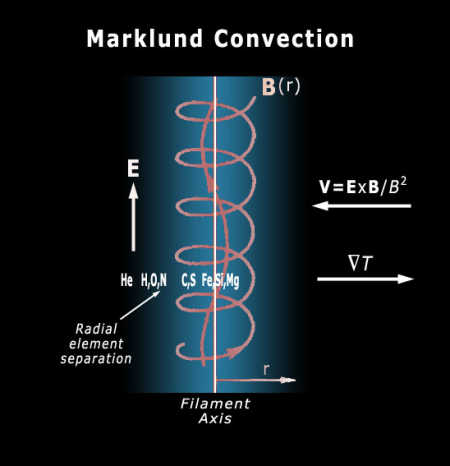
Another important phenomenon known as ‘Marklund convection’ occurs
along the discharge axis. It separates the chemical elements radially.
Marklund convection causes helium to form a diffuse outer layer,
followed by a hydrogen layer, then oxygen and nitrogen in the middle
layers, and iron, silicon and magnesium in the inner layers. So
electric stars should have a core of heavy elements and an upper
atmosphere mostly of hydrogen. This renders the difference between
stars and planets to be more apparent than real.
In addition to scavenging elements, stars produce electrically in
the high-energy electrical discharges of their photospheres all of
the elements required to form rocky planets. Nucleosynthesis of
heavy elements does not require a supernova explosion. Planets are
then born by electrical expulsion of matter from the body of the
star in the form of giant mass ejection events, like we see in
miniature in solar outbursts. Large stellar flares and nova outbursts
probably signal the birth of planets. Disks of matter encircling
stars are not due to gravitational accretion but to electrical expulsion.
STAR LIGHT
The bright photosphere of a star is an electric discharge high in
its upper atmosphere that can be compared directly with low-pressure
glow discharges in the lab. The spectrum of the photosphere reflects
the star’s upper atmosphere composition, which is largely hydrogen.
The heavy elements seen in the spectrum are produced right before
our eyes in the photospheric discharge.
Measurements of stellar radii are misleading since the photosphere
is a bright plasma ‘skin’ at great height in the atmosphere above
the solid surface of the star. That height, in the case of the Sun,
may be estimated simplistically as follows: the Sun has a mass
equivalent to 333,000 Earths; if most of the mass of the Sun is in
heavy elements similar to the Earth, the Sun would have a solid
diameter somewhat less than 900,000 kilometers, compared to its
optical diameter of 1.4 million kilometers. That suggests the
photosphere is some 250,000 kilometers above the surface of the
Sun.
Note: An immediate objection may be raised by helioseismologists,
who claim to be able to determine what is going on inside the Sun
by the way the Sun ‘rings like a bell.’ However, helioseismology
assumes the standard thermonuclear model of stars and interprets
the oscillations of the photosphere as a purely mechanical
phenomenon. In fact, the question of what causes the Sun’s
‘ringing’ remains unanswered.
"The flute does not produce music unless one blows
in it. Therefore one is led to the question: who is blowing
the pipe? " J. C. Pecker —Solar Interior and Atmosphere.
On the other hand, a fundamental characteristic of plasma
double layers is that they are driven electromagnetically to
oscillate. Photospheric oscillations are properly the study
of double layers and stellar circuits, not mechanical sound
waves. This study has wider applications than to photospheric
‘ringing.’ For example, the regular pulsations of ‘neutron
stars,’ conventionally attributed to a "runaway
lighthouse effect," are better explained by oscillations
in the magnetospheric circuit of a normal, lazily rotating
and externally powered electric star.
A star is a pinpoint object at the center of a vast plasma
sheath. The plasma sheath forms the boundary of the electrical
influence of the star, where it meets the electrical environment
of the galaxy. The Sun’s plasma sheath, or ‘heliosphere’ is
about 100 times more distant than the Earth is from the Sun.
To give an idea of the immensity of the heliosphere, all of
the stars in the Milky Way could fit inside a sphere encompassed
by the orbit of Pluto. The Sun’s heliosphere could accommodate
the stars from 1000 Milky Ways!
Note:
Voyager 1 has begun sampling the heliosphere and the
results do not meet the expectations of a mechanical shock
interaction. But they do meet the
plasma sheath interpretation.
Clearly, in the immense volume of the heliosphere an
unmeasurably small drift of electrons toward the Sun and
ions away from the Sun (the solar wind) can satisfy the
electrical power required to light the Sun. It is only
when we get very close to the Sun that the current density
becomes appreciable and plasma discharge effects become visible.
The enigma of the Sun’s millions-of-degrees corona above a
relatively ‘stone cold’ photosphere is immediately solved when
the Sun’s power comes from the galaxy and not the center of the Sun!
It is clear from the behavior of its relatively cool photosphere
that the Sun is an anode, or positively charged electrode, in a
galactic discharge. The red chromosphere is the counterpart to
the glow above the anode surface in a discharge tube. When the
current density is too high for the anode surface to accommodate,
a bright secondary plasma forms within the primary plasma. It is
termed "anode tufting." On the Sun, the tufts are packed
together tightly so that their tops give the appearance of
"granulation."
CONSTANT STARSHINE
The Sun is a variable X-ray star; it is fortunate for us that
the variability is not reflected in the energy flux in the visible.
— R L F Boyd, Space Physics:
the study of plasmas in space.
We rely on the Sun to shine steadily. The variation in light and
heat is measured to be a fraction of one percent from year to
year. Yet the Sun is a variable star when viewed in X-rays. And
X-rays are emitted where electrical activity is most intense.
>> Seen above in X-rays by
the Yokhoh satellite, from solar minimum to maximum, the Sun
is a variable star. X-rays are the signature of electric
arcs.
When considered without tunnel vision, it is obvious that
stars with a thermonuclear core are not likely to be stable.
So sensitive to core temperature are some of the nuclear
reactions that the night sky should look like the fourth of
July.
Juergens went to great pains to explain the complex and exquisitely
tuned control mechanism of the solar discharge. His insights are of
paramount importance for an understanding of the Sun and for
clarity on one of the most frequently asked questions: can we rely
upon the Sun as a constant source of life-giving energy? As noticed
by Scott, the tufted plasma sheath above the stellar anode seems to
be the cosmic equivalent of a ‘PNP transistor,’ a simple electronic
device using small changes in voltage to control large changes in
electrical power output. The tufted sheath thus regulates the solar
discharge and provides stability of radiated heat and light output,
while the power to the Sun varies throughout the sunspot cycle.
>> The Sun’s plasma sheath. The
white curve shows how the voltage changes within the solar plasma
as we move outward from the body of the Sun. Positively charged
protons will tend to "roll down the hills." So the
photospheric tuft plasma acts as a barrier to limit the Sun’s power
output. The plateau between (b) and (c) and beyond (e) defines a
normal quasi-neutral plasma. The chromosphere has a strong electric
field which flattens out but remains non-zero throughout the solar
system. As protons accelerate down the chromospheric slope, heading
to the right, they encounter turbulence at (e), which heats the
solar corona to millions of degrees. The small, but relatively
constant, accelerating voltage gradient beyond the corona is
responsible for accelerating the solar wind away from the Sun.
Credit: W. Thornhill (after W. Allis & R. Juergens), The
Electric Universe.
This ability of the Sun’s plasma sheath to modulate the solar
current was demonstrated dramatically in May 1999, when the solar
wind stopped for two days. The bizarre event makes no sense if
the solar wind is being ‘boiled off’ by the hot solar corona. But
in electrical terms, its regulating plasma sheath performed
normally and there was no noticeable change in the Sun’s radiant
output.
SUNSPOTS
Note: Sunspots are a phenomenon that is not expected in the standard
thermonuclear model of stars. "The very existence of sunspots
is intriguing. They should be heated quickly from the sides and
disappear. They should never have formed — but they do form. Their
behavior is so strange that there is still argument between scientists
as to why they are there at all. " — Ronald Giovanelli,
Secrets of the Sun..
[Click on image to enlarge]
Sunspots are a clearing of the tufts where a dark discharge
from an equatorial plasma toroid encircling the Sun punches
through them. Birkeland had the general idea figured out in 1913!
The dark center, or umbra, of the sunspot shows the cooler
temperature of the Sun beneath the bright plasma. The sunspot
penumbra, in which we are looking at the sides of the "hole"
punched through the tuft layer, shows the structure of the tufts.
They are bright tornadic cylinders of plasma, thousands of kilometers
long. Tornadoes are constrained by strong electromagnetic forces to
be a slow form of lightning discharge. This explains why solar
granulations last for about 10 minutes before slowly fading to be
replaced by others. They have nothing to do with convection, although
they do dredge material from below.
SOLAR MAGNETISM
One of the greatest mysteries of the Sun is the sunspot cycle. It
is intimately associated with that other great puzzle — the Sun’s
magnetic field. This puzzle is that it is extremely difficult to
conjure a magnetic field from inside a hot ball of conducting
plasma, particularly when the solar magnetic field shows amazing
complexity and often rapid variability.
The Sun has a generally dipole magnetic field that switches polarity
with the sunspot cycle. Unlike a dipole magnet, in which the field
is twice as strong at the poles as at the equator, the Sun has very
evenly distributed field strength. This oddity can be explained only
if the Sun is the recipient of electric currents flowing radially
into it. These magnetic field-aligned currents adjust the contours
of the magnetic field by their natural tendency to space themselves
evenly over an anode surface. An internal dynamo will not produce
this magnetic field pattern.
The Sun’s interplanetary magnetic field increases in strength with
sunspot number. Electrically, the relationship is essential, since
the interplanetary magnetic field is generated by the current flow
to and from the Sun. As the power increases, sunspot numbers rise
(reflecting current input) and the magnetic field strengthens.
The standard thermonuclear star theory has no coherent explanation
for the approximately eleven-year sunspot cycle. In the electrical
model the sunspot cycle is induced by fluctuations in the DC power
supply from the local arm of our galaxy, the Milky Way, as the
varying current density and magnetic fields of huge Birkeland
current filaments slowly rotate past our solar system. The solar
magnetic field reversals may be a result of simple ‘transformer’
action.
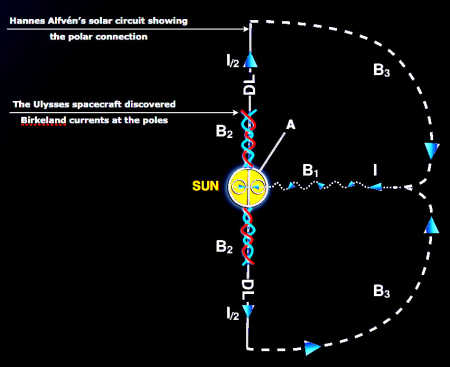
[Click on image to enlarge]
>> "Primary and secondary
electric currents in the Sun." Using Alfvén’s circuit
diagram of the Sun, Professor Scott offers the following explanation
for solar magnetic field reversals: "If the main magnetic
field that induces the surface currents is growing in strength,
the surface current will point in one direction. If the main magnetic
field weakens, the secondary surface currents will reverse direction.
" This ‘transformer’ action does not require the solar
driving current to reverse direction.
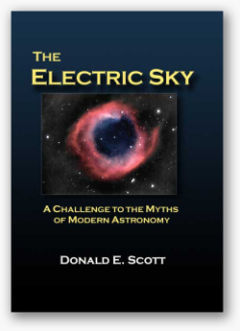
Credit: Diagram and explanation are from D. E. Scott’s
The Electric Sky.
DIFFERENT LIGHTS
Electric lights come in a wide variety. There are the original
incandescent filament lamps where the light comes from a filament
heated internally by electric current. And today we have fluorescent
lights, high-intensity gas discharge lamps, arc lights, neon lights
and solid-state light emitting diodes (LEDs).
Stars fall into the categories of neon lights, gas discharge lamps
and arc lights. They are not incandescent (heated from within). The
main differences between these types of lights are the power density
of the discharge and the location in the gas discharge path where
most of the light comes from. For example, in a neon tube the light
comes from the extensive plasma column between the electrodes at each
end of the tube. In an arc light, the light is concentrated at the
electrode. As the power of an arc light is increased its color changes
from yellow-white to white to blue-white. The sharp discontinuities in
the nature of the light from an electric discharge as it switches from
a red glow to a bright arc explain many of the mysteries of starlight.
Astronomers use the Herzsprung-Russell (H-R) diagram to categorize
stars. It is a plot of the absolute brightness of stars against their
spectral class (temperature).
[Click on image to enlarge]
The data graphed by the H-R diagram are observed quantities,
while assumptions drawn about the diagram’s meaning are not.
Clearly, not being electrical engineers, astronomers have got
things precisely backwards (left). As you increase the current
density to an electric arc, the light becomes brighter, hotter,
and therefore bluer. In other words, the current density is
responsible for both the luminosity (y-axis) and the color
temperature (x axis) of the H-R diagram. That explains the near
45°slope of the so-called ‘main sequence’ stars in the
corrected H-R diagram (right).
At the lower left-hand end of the main sequence we find the red
dwarfs – small stars under low electrical stress, in which anode
tufting is sparse and the light from the tufts is emitted at low
energies, toward the red end of the spectrum. A good deal of the
red light comes from the chromospheric anode glow.
As we move diagonally upward and to the right on the H-R diagram
the stars become more massive and the current density increases.
Anode tufting becomes more intense and the tufts’ mutual repulsion
forces the photosphere to grow to accommodate them. At the top
right of the main sequence the light from the tufts is the electric
blue of a true arc and the stars appear as ‘blue giants’ — intensely
hot objects considerably larger than our Sun. These blue giants tend
to be concentrated on the central axes of our galaxy’s spiral
arms, where the galactic currents are strongest.
But what about the stragglers — the red giants and the white dwarfs?
Here the natural simplicity of the electric star model shines.
Stellar color and luminosity are discontinuous functions for good
reason: plasma discharge phenomena at an anode exhibit sharp
discontinuities. Thermonuclear star models projecting theoretical
stellar evolution onto the H-R diagram require great imagination to
explain these discontinuities. Usually it requires that a star
explodes, or else the transition off the main sequence is said to
be so rapid that we don’t see a continuous plot. The terms ‘giant’
and ‘dwarf,’ when applied to these stars, are highly misleading
since a star’s size is a plasma phenomenon too. And the notions that
a red giant is an old, dying star, and that a white dwarf is a
remnant of an exploded star, have no validity.
WHITE DWARFS
Eddington himself expressed his puzzlement about white dwarfs:
"Strange objects, which persist in showing a type of
spectrum entirely out of keeping with their luminosity, may
ultimately teach us more than a host which radiates according
to rule. " He was right.
A white dwarf is a star that is under low electrical stress so
that bright ‘anode tufting’ is not required. The star appears
extremely hot, white and under-luminous because it is equivalent
to having the faint white corona discharge of the Sun reach down
to the star’s atmosphere. As usual, a thin plasma sheath will be
formed between the plasma of the star and the plasma of space.
The electric field across the plasma sheath is capable of
accelerating electrons to generate X-rays when they hit atoms in
the atmosphere. And the power dissipated is capable of raising
the temperature of a thin plasma layer to tens of thousands of
degrees.
White dwarfs are often found in multiple star systems, which
puzzles astronomers because "it is not easy to understand
how two stars of the same age could be so different." The
answer is simple. The appearance of stars has nothing to do
with their age. In multiple star systems the brighter primary
star usurps most of the electrical power, dissipating the energy
in optical wavelengths. The white dwarf converts its share of
power most efficiently into X-rays.
An example is the nearby double star system of Sirius, which
is the brightest star in the sky and one of the closest. Sirius
also has a partner, called Sirius B, a ‘white dwarf.’ To our eyes,
it is 10,000 times fainter than the primary star, Sirius A. However,
when astronomers pointed the Chandra X-ray telescope at Sirius, they
got a shock. In the X-ray image (right), Sirius A is the lesser of
the two lights. Sirius B, the white dwarf, is the greater. It is the
reverse of what we see with human eyes.
RED GIANTS
Red stars are those stars that cannot satisfy their hunger for
electrons from the surrounding plasma. So the star expands the
surface area over which it collects electrons by growing a large
plasma sheath that becomes the effective anode in space. The
growth process is self-limiting because, as the sheath expands,
its electric field will grow stronger. Electrons caught up in the
field are accelerated to ever-greater energies. Before long, they
become energetic enough to excite neutral particles they chance
to collide with, and the huge sheath takes on a uniform ‘red anode
glow.’ It becomes a red giant star.
The electric field driving this process will also give rise to a
massive flow of positive ions away from the star, or in more
familiar words—a prodigious stellar ‘wind.’ Indeed, such mass
loss is a characteristic feature of red giants. Standard stellar
theory is at a loss to explain this since the star is said to be
too ‘cold’ to ‘boil off’ a stellar wind. So when seen in electric
terms, instead of being near the end point of its life, a red
giant may be a ‘child’ losing sufficient mass and charge to begin
the next phase of its existence— on the main sequence.
COMING TO TERMS WITH ELECTRIC STARS
Electric stars change forever the picture of our place in the
universe. At first the idea of electric stars is unsettling.
The comforting fable about the history of the Sun and its
reliability for billions of years into the future is gone.
Reliability now depends upon the steadiness of power from the
Milky Way itself. Nearby stars look steady enough. But there
is no guarantee that surges and brown-outs will not interrupt
the electric Sun’s steady shining for millions, let alone
billions, of years into the future.
>> The Allen Telescope Array.
This is the first phase of a planned 350 radio dishes that will
advance the capabilities of radio astronomy research. This array
is named after Paul G. Allen, Microsoft co-founder and
philanthropist whose foundation donated seed money that started
the project in 2001.
Electric stars offer radically new ideas about life on other worlds
and the search for extra-terrestrial intelligence (SETI). A galactic
source of electrical energy provides more possibilities for sustaining
life in the universe than the lottery of finding an Earth-like planet
orbiting in a narrow ‘habitable zone’ about a bright star like the Sun.
The probability of the latter occurrence is not high. But with electric
stars, we can turn to the most numerous stars in the galaxy as likely
incubators of life — the brown ‘dwarfs.’ They could be described as
‘cosmic eggs.’
Imagine giant Jupiter and its moons floating independently in deep
space. Outside the Sun’s dominating electrical influence, Jupiter
would become a dim electric star enclosed in the huge radiant red
plasma shell of its ‘anode glow’ — a brown dwarf. Inside the glowing
sheath is the most hospitable environment in the universe for life
because the radiant energy received by each satellite is evenly
distributed over its entire surface. There are no seasons, no tropics
and no ice caps.
The radiant energy from the plasma cell of a brown dwarf star is
strongest at the blue and red ends of the spectrum. Photosynthesis
relies on red light. L-type brown dwarfs have water as a dominant
molecule in their spectra, along with many other biologically
important molecules and elements. Satellites would accumulate
atmospheres from the brown dwarf and water would mist down.
Regardless of its spin and axial tilt, a satellite orbiting inside
the sheath of a brown dwarf could experience an ideal environment
for life.
It is instructive to note the icy nature of the moons of our gas
giant planets. Those planets may be electrically captured brown
dwarf stars. That would explain their odd axial tilts, excess heat,
and remnants of expulsion disks or rings.
However, the brown dwarf ‘Garden of Eden’ comes with a caveat.
Stars off the main sequence do not have the self-regulating
photospheric discharge to smooth out variations in electrical
power input. Consequently, brown dwarfs are subject to sudden
outbursts, or ‘flaring,’ when they encounter a surge in the
circuit that powers them. These flares could cause sparking
to and between the satellites orbiting inside the sheath and
lead to sudden extinction events, vast fallout deposits and
fossilization. There is much food for new thoughts!
WHY NO CALL FROM ET?
The problem for SETI is that no radio signals can penetrate the
glowing plasma shell of such a brown dwarf star. Even the dim
twinkling of other stars would be obscured. Intelligent life
forms living on the satellites of a brown dwarf star would be
unaware of the spectacle of the universe that we are privileged
to witness. Seeing only a purple glow in their sky, they would
have no cause to attempt to communicate. This may explain why
SETI hears only eerie static on the galactic phone.
CONCLUSION
Eddington remarks, in the conclusion to The Internal Constitution
of the Stars, "The history of scientific progress
teaches us to keep an open mind. I do not think we need feel greatly
concerned as to whether these rude attempts to explore the interior
of a star have brought us to anything like the final truth. "
Fine words, but his prejudice cannot be contained, "The partial
results already obtained encourage us to think that we are not far
from the right track… it is reasonable to hope that in a not too
distant future we shall be competent to understand so simple a thing
as a star. " We are swiftly approaching the centenary of
Eddington’s publication without that understanding.
The standard model of stars has become a nightmare of complexity and
special pleading (miracles). The situation may be due to bad timing.
Before Eddington, the principal difficulty was to find a long-lived,
steady source of energy for the Sun. In 1862, William Thomson (later
known as Lord Kelvin) wrote On the Age of the Sun’s Heat,
"It seems therefore, on the whole most probable that the Sun
has not illuminated the Earth for 100, 000,000 years, and almost
certain that he has not done so for 500, 000,000 years. As for the
future, we may say, with equal certainty, that inhabitants of the
Earth cannot continue to enjoy the light and heat essential to their
life, for many millions of years longer, unless sources now unknown
to us are prepared in the great storehouse of creation. "
The unlocking of the energy of the atom in Eddington’s time seemed to
provide the "great storehouse of creation." Meanwhile the
study of electric discharges in low-pressure gases was in its infancy.
Eddington recognized the difficulties in explaining how lethal nuclear
energy could be released in relatively stone cold stars and converted
to benign sunshine. The difficulties were overcome gradually by
inventing a truly "Heath Robinson" model. Since hydrogen was
necessary as fuel, this lightest of elements had to be in the core of
the star as well as its atmosphere. The deadly high-energy radiation
from the thermonuclear core had to be tamed by proposing an extensive
radiation zone between the core and the surface of the star, where
scattering of the radiation over a million years could tame it. No known
physical body exists that transfers internal heat by radiation. Finally
the heat reaches the surface by convection. But the solar granulation
doesn’t behave like convection of hot hydrogen. Despite these seemingly
fatal objections, the desperate need to explain how the Sun works
over-rode commonsense. Meanwhile, the many strange solar phenomena in
plain view that had no place in the thermonuclear model were pushed to
one side. There they remain.
While enormous time and resources have been poured into the effort to
understand stars based on a single outdated idea, those familiar with
plasma discharge phenomena have been paying close attention to the
observed phenomena on the Sun and finding simple electrical explanations.
After 100 years of neglect, an electrical model of stars is just beginning
to emerge. It is an engineer’s view that offers a coherent understanding
of our real place in the universe (cosmology) and practical insights for
the future exploration of space. If the Sun shines as an electric light
‘plugged in’ to the Electric Universe, the objective tests become obvious.
Perhaps, with a real understanding of stars we may reach childhood’s end
in the cosmos.
For much more detail see
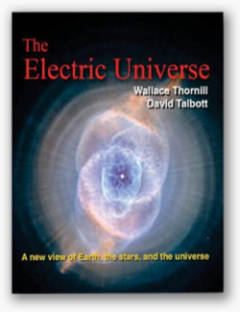
The Electric Universe book.
Permalink to this article.
Public comment may be made on this article on the
Thunderbolts Forum/Thunderblogs (free membership required).
For a highly-acclaimed 60-minute video introduction to the
Electric Universe, see
Thunderbolts of the Gods on Google Video.
|
Wallace Thornhill
Recent Articles
My Archive
See Holoscience.com
News and Views
Archive Index
Archives by Subject
Thunderblogs home
|