|
|
Nebular Currents
Jan
26, 2010
Electric
Universe theory proposes that most
of the Universe is behaving
according to the laws of plasma
dynamics.In every science
journal discussing the behavior of
planetary nebulae, the prevailing
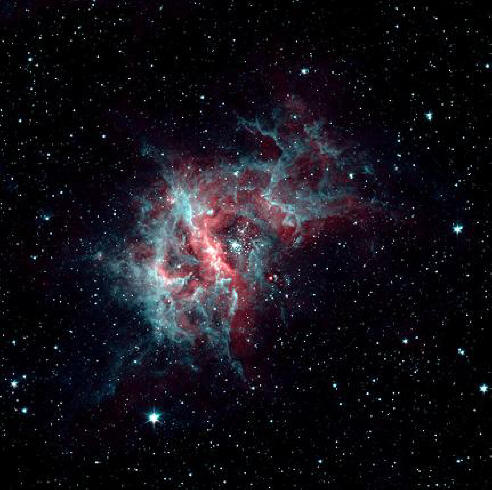
description of regions like RWW49
usually involves gases and dust
"blowing" through them, as well as
"winds" created by "shock waves"
from exploding stars. In many cases,
such as RCW49, the nebula is
described as "star forming," because
intense points of x-ray radiation,
or extreme ultraviolet, indicate to
astronomers that new thermonuclear
fusion reactions have begun within
the cloud.
The Electric Universe sees things
differently. Plasma, not hot gas, is
flowing through space. The physics
of electric currents apply, not the
physics of winds. Within the shell
of a planetary nebula are one or
more plasma sheaths, or "double
layers," that act like capacitors,
alternately storing and releasing
electrical energy. The current flow
alternately increases and decreases
within the sheaths inside and
outside the shell.
Charged particles in motion
constitute an electric current which
take the form of plasma filaments.
An electric current is accompanied
by a magnetic field that wraps
around the current filament and
diminishes linearly with the
distance from it.
An electric current filament in
plasma may create a double layer
along its axis. Positive charge
builds up on one side and negative
charge on the other side of the
double layer. A strong e-field
exists between the two charge layers
and if enough current is applied the
double layer will glow, but it is
otherwise detectable only by its
emission of radio noise. Double
layers and current filaments form in
the circuit that threads through the
galaxy. They are mostly invisible
because of their low current
density, but the magnetic fields
they produce can be mapped by radio
telescopes.
A neon lamp that emits light only at
the excitation frequency of a
specific gas is a more correct model
for nebulae. Electricity passing
through neon gas causes it to form a
plasma and to glow a pale yellow.
Other gases, such as oxygen or
hydrogen, produce blue and red
light, while heavier elements emit
their own colors.
Plasma behavior is unfamiliar in
many ways. It is often difficult to
see plasma as completely different
from a gas. Plasma's similarities to
gas are overshadowed by its failure
to correspond with gas kinetics.
Since more than 90% of the light
frequencies from planetary nebulae
are in the ionized oxygen range,
they should be thought of as oxygen
discharge tubes and not balls of
gas.
Ideas like this are unfamiliar to
astronomers who think in absolute
terms of gravity and mass—they
seldom think about charges. They
think of moving charges from the Sun
as a “solar wind” instead of an
electric current. They think of
charged particles impacting a planet
or moon as a “rain” instead of an
electrical discharge. They think of
charged particles moving along a
magnetic field as a “jet” instead of
a field-aligned Birkeland current.
They think of abrupt changes in the
density and speed of charged
particles as a “shock wave” instead
of a double layer that can even
explode.
As astronomer Amy Acheson wrote:
"It’s been over 300 years since
Newton encountered his apple, and
his conception of gravity, now
modified by Einstein and
supplemented with similar mechanical
theories of solids, liquids and
gasses, has become the popular
vision of space—an almost-empty
universe of self-contained bodies.
And now it’s been 100 years since
Birkeland encountered his aurora,
and his conception of electric
currents in space, developed by such
pioneers as Irving Langmuir and
Hannes Alfven, has been a footnote
to standard theory, rarely called
upon except to explain the
occasional curiosity in space."
It's about time that the simple more
straightforward explanations are
remembered and not the arcane,
overly complex hyperbole that seems
to be the standard for scientific
papers today.
Stephen Smith
|
|
|
|
|
|
|
|
|
YouTube video, first glimpses of Episode Two in the "Symbols of an Alien Sky"
series.
|
|
|
|
|
|
|
Three ebooks in the Universe Electric series are
now available. Consistently
praised for easily understandable text and exquisite graphics.
|
|
|
|
|
|
|
|
|
|