Spotless Sun
-
Osmosis
- Posts: 423
- Joined: Wed Mar 19, 2008 3:52 pm
- Location: San Jose, California
Re: Spotless Sun
-----And remember ancient libraries---

-
Lloyd
- Posts: 4433
- Joined: Fri Apr 04, 2008 2:54 pm
Re: Spotless Sun
* So what happens to the galactic B-field, the interstella plasma flow and the sun's B-field orientation every 11 years to cause the solar jet streams and the faculae and sunspot motions? Would it be mainly the sun's B-field orientation that changes every 11 years? If so, what causes the changes in the sun's B-field orientation every 11 years?Tolenio: So the ~standard galactic magnetic field, the ~standard interstellar plasma flow distribution, and the sun's magnetic field's orientation to the flow of plasma all contribute to the ~standard solar cycles we see which include the 11 year sunspot cycle, and the 80-130 year Wolf/Gleissberg cycle (among others). It is all about plasma density as our sun passes through it and its orentation to that plasma.
http://thunderbolts.info/wp/forum/phpBB3/v ... =15#p22622
- tolenio
- Posts: 244
- Joined: Mon Mar 17, 2008 5:17 am
Re: Spotless Sun
Hi,
I would presume it passes through weak magnetic field areas and strong magnetic field areas at ~11 year intervals.
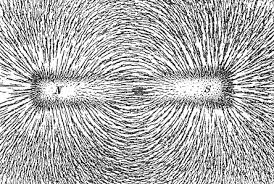
Using this very basic magnetic field, would you say it has a ~standard distribution?

Now imagine that the area between the lines is a weak magnetic field (the weakest dead center between the lines) and weaker magnetic field attract and transports less interstellar plasma. Now look at the lines and imagine they transport more peak plasma than the weaker areas.
As the sun approaches a peak area more plasma is introduced to the sun. As it moves away from the peak area there is less plasma and it becomes less active.
You have a somewhat standard variation from high to low that the sun moves through as it orbits and osciallates the galaxy.
When you rotate that maggnetic field it does change shape and this is a simplistic view, but it gives you a window into the idea.
Tom
I would presume it passes through weak magnetic field areas and strong magnetic field areas at ~11 year intervals.
Using this very basic magnetic field, would you say it has a ~standard distribution?

Now imagine that the area between the lines is a weak magnetic field (the weakest dead center between the lines) and weaker magnetic field attract and transports less interstellar plasma. Now look at the lines and imagine they transport more peak plasma than the weaker areas.
As the sun approaches a peak area more plasma is introduced to the sun. As it moves away from the peak area there is less plasma and it becomes less active.
You have a somewhat standard variation from high to low that the sun moves through as it orbits and osciallates the galaxy.
When you rotate that maggnetic field it does change shape and this is a simplistic view, but it gives you a window into the idea.
Tom
"The Pharisees and the scholars have taken the keys of knowledge and have hidden them. They have not entered nor have they allowed those who want to enter to do so. As for you, be as sly as snakes and as simple as doves." Gospel of Thomas http://www.gnosis.org/naghamm/gthlamb.html
-
Lloyd
- Posts: 4433
- Joined: Fri Apr 04, 2008 2:54 pm
Re: Spotless Sun
* Isn't it the plasma flows that create the magnetic fields, rather than the B-fields moving the plasma?Tolenio Tom: Now imagine that the area between the lines is a weak magnetic field (the weakest dead center between the lines) and weaker magnetic field attract and transports less interstellar plasma. Now look at the lines and imagine they transport more peak plasma than the weaker areas.
* Also, where is the interstellar plasma you're referring to?
* The plasma flow that we know of is the solar wind, which is positively charged plasma, and it's moving outward from the sun, rather than inward toward the sun, and I think the solar wind is confined mostly to the equatorial portion of the heliosphere.
* Has a negatively charged plasma flow been detected yet? I think our main EU theorists suppose that this plasma flow is inward toward the sun's polar regions and is mostly electrons. How would that affect your idea?
* The sun's B-field is only about 1 gauss on average, although the areas of sunspots get up to 4,000 gauss, I think. Would that 4,000 gauss be along a plasma filament or stream impinging on the sun? Or would it just be localized on the surface of the sun only? Even 4,000 gauss is pretty weak. If a refrigerator magnet is about 100 gauss, 4,000 would be equivalent to 40 refrigerator magnets. That doesn't seem like a very strong attractant. So it seems to me that the E-field would be the determining factor of the plasma flow, rather than the B-field. Si?
- MGmirkin
- Moderator
- Posts: 1667
- Joined: Thu Mar 13, 2008 11:00 pm
- Location: Beaverton, Oregon, USA
- Contact:
Re: Spotless Sun
Well, why not see what they actually say rather than putting words in their mouths?Lloyd wrote:I think our main EU theorists suppose ...
(The Electric Sun Hypothesis)
http://www.electric-cosmos.org/sun.htm
Though within the overall spherical geometry, there may be additional structure, such as the helisopheric current sheet approximately along the equatorial plane, and and probably similar polar features.When we consider the Sun, however, a spherical geometry exists - with the sun at the center. The cross-section becomes an imaginary sphere. Assume a constant total electron drift moving from all directions toward the Sun and a constant total radial flow of +ions outward. Imagine a spherical surface of large radius through which this total current passes. As we approach the Sun from deep space, this spherical surface has an ever decreasing area. Therefore, for a fixed total current, the current density (A/m^2) increases as we move inward toward the Sun.
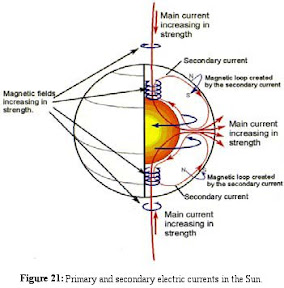
(Don Scott's appx. gross circuit diagram near the sun.)

Other diagrams for the voltage drop, charge density and such near the Sun (according to Don's hypothesis) are available from the page listed above.
See also:
(Voyager 1 at the Edge – of what?)
http://www.holoscience.com/news.php?article=0yfteeje
Addendum: Just found the following image by accident on Wikipedia. Submitted by Ian Tresman some time ago.
>> Diagram showing the important electrical features of a glow discharge aligned with the heliosphere and with the Sun as the anode. Note that in a spherically symmetrical corona discharge the cathode glows and extensive positive column glow are absent because the drift current is spread through a huge volume. The heliosphere boundary is a double layer with charge concentrations shown. A reverse electric field is strongest at the point of inflection between the two charge concentrations.
Discharge diagram from J. D. Cobine's Gaseous Conductors.
Figured it might help make sense of the glow discharge analogy... Figure 3 would equate to something like Wal's assessment of the solar-system-as-glow-discharge model.
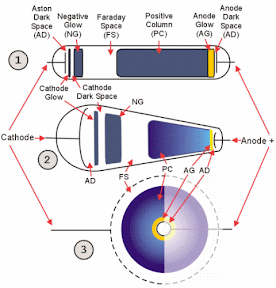
Figure 1 shows what can happen when an electric current passes through a gas discharge tube. A number of visual phenomena may appear, depending on the gas pressure, voltage across the tube, tube length, gas type, and other factors. It should be noted that at the cathode (the source of electrons), the electron density is the same as at the anode.
Figure 2 shows a hypothetical "funnel-shaped" glow discharge tube, in which the cathode is much larger than the anode; the electron density increases towards the anode.
Figure 3 shows a spherical glow discharge tube. The cathode has become a "virtual cathode", and some the glow discharge phenomena have disappeared. The electron density at the anode is much greater than at the virtual cathode.
(Voyager Probes the Sun's Electrical Environment)
http://www.holoscience.com/news.php?article=55fx8yeh
Again, in general it's an analogy to a spherical glow discharge, with a virtual cathode at the heliospheric boundary (heliopause), and the sun as the anode at a much higher voltage with respect to surrounding space, holding a positive charge. Planets play the role of secondary cathodes (generally holding a lower voltage with respect to their surrounds and/or a negative charge) in this glow discharge analogy.
That said, Wal does also talk about polar currents and equatorial currents here:
(THE SUN — Our Variable Star)
http://www.holoscience.com/news.php?article=by2r22xg
(Scientists fail to unravel the kinks in solar waves)9. The current that powers the Sun can be viewed as flowing in along the wavy polar magnetic field lines, then from the poles toward the equator. That current flow manifests as huge sub-photospheric flows of gas. In the mid-latitudes the circuit is completed as the current flows outward in a current sheet called incorrectly the solar 'wind.'
http://www.holoscience.com/news/kinks.htm
Now, two things...What is fascinating is that astrophysicists cannot "see" what they are looking at because of the dogma that electric currents cannot flow in space and the Sun cannot be electrically charged. The thin, straight tubes are diagnostic of Birkeland currents. Birkeland currents also have an outer twisted filament or rope-like form taken by electric current flowing in plasma. The Alfven waves are therefore more likely to be the structure of the magnetic field associated with Birkeland currents. Otherwise there is some unspecified activity required beneath the Sun's surface to excite the Alfven waves, or "pluck the guitar string" as it is colorfully described. Unfortunately this "explanation" follows a well-established tradition of ascribing every weird feature of the Sun to poorly defined activity hidden from view inside the Sun. It is what is known as "pathological science" - a term coined by a pioneer of plasma physics and Nobel Laureate, Irving Langmuir.
Alfven's and Don's circuit diagrams appear to reverse the directional arrows for the circuit. I believe, and Don I think agreed a while back that this was simply due to tracking opposite particle signs. IE, Alfven's circuit diagram keyed off of electron motions (electron currents), whereas Don's diagram (and Wal's mention of polar and equatorial currents) keys off the motion of protons or +ions (conventional current). As we know, in the same circuit, positive charges flow in one direction and negative charges flow the opposite direction. So, really, the direction of the arrows in both diagrams denote the same circuit, just keying off the motions of oppositely charged particles.
& again, I might try to clarify on the statements of "spherical glow discharge" versus specific structures (equatorial and polar). IE, are the ideas mutually exclusive, or complementary. IE, is the overall structure one or the other, or does it include both (IE, a generally spherical discharge but with larger amounts of the discharge concentrated in the regions structurally located in the solar polar regions and the solar equatorial region)? Might have to get back to folks on that one... I think the latter though (generally spherical, AKA the heliosphere, but with certain internal structure, AKA the equatorial heliospheric current sheet / solar wind and polar plume[s]).
Addendum: Having just seen and added the bit on the polar plumes, above, the latter seems to be the most likely. An overall sperhical-esque heliosphere / virtual cathode, but with definite internal structures (polar plumes and equatorial heliospheric current sheet)...
Best,
~Michael Gmirkin
"The purpose of science is to investigate the unexplained, not to explain the uninvestigated." ~Dr. Stephen Rorke
"For every PhD there is an equal and opposite PhD." ~Gibson's law
- MGmirkin
- Moderator
- Posts: 1667
- Joined: Thu Mar 13, 2008 11:00 pm
- Location: Beaverton, Oregon, USA
- Contact:
Re: Spotless Sun
From the above post, it would seem more like:Lloyd wrote:this plasma flow is inward toward the sun's polar regions and is mostly electrons.
Poles: Electrons -- outward, Protons / +ions -- inward.
Equator: Electrons -- Inward, Protons / +ions -- outward.
Per Don's circuit diagram from the regions inside and close to the sun.
Though seems like they're saying that in general or overall, there is a spherical inflow of electrons and a spherical outflow of protons / +ions (on account of the theoretical high positive charge of the sun).
I hope I'm not too far off on that.
Best,
~Michael Gmirkin
"The purpose of science is to investigate the unexplained, not to explain the uninvestigated." ~Dr. Stephen Rorke
"For every PhD there is an equal and opposite PhD." ~Gibson's law
-
earls
- Posts: 275
- Joined: Thu Mar 20, 2008 6:48 am
Re: Spotless Sun
So with that knowledge, how can we build our own sun? What would this device look like.
-
flyingcloud
- Posts: 490
- Joined: Fri Nov 07, 2008 2:07 am
- Location: Honey Brook
Re: Spotless Sun
http://www.spaceweather.com/
ARE SUNSPOTS DISAPPEARING? Sunspots are made of magnetism. The "firmament" of a sunspot is not matter but rather a strong magnetic field that appears dark because it blocks the upflow of heat from the sun's fiery depths. Without magnetism, there would be no sunspots.
That's what makes the following graph a little troubling:
According to Bill Livingston and Matt Penn of the National Solar Observatory in Tucson, Arizona, sunspot magnetic fields are waning. The two respected solar astronomers have been measuring solar magnetism since 1992. Their technique is based on Zeeman splitting of infrared spectral lines emitted by iron atoms in the vicinity of sunspots. Extrapolating their data into the future suggests that sunspots could completely disappear within decades. That would be a bummer for Spaceweather.com.
Don't count out sunspots just yet, however. While the data of Livingston and Penn are widely thought to be correct, far-reaching extrapolations may be premature. This type of measurement is relatively new, and the data reaches back less than 17 years. "Whether this is an omen of long-term sunspot decline, analogous to the Maunder Minimum, remains to be seen," they caution in a recent EOS article.
One thing is certain. Solar Minimum is a lot more interesting than it sounds: more.
ARE SUNSPOTS DISAPPEARING? Sunspots are made of magnetism. The "firmament" of a sunspot is not matter but rather a strong magnetic field that appears dark because it blocks the upflow of heat from the sun's fiery depths. Without magnetism, there would be no sunspots.
That's what makes the following graph a little troubling:
According to Bill Livingston and Matt Penn of the National Solar Observatory in Tucson, Arizona, sunspot magnetic fields are waning. The two respected solar astronomers have been measuring solar magnetism since 1992. Their technique is based on Zeeman splitting of infrared spectral lines emitted by iron atoms in the vicinity of sunspots. Extrapolating their data into the future suggests that sunspots could completely disappear within decades. That would be a bummer for Spaceweather.com.
Don't count out sunspots just yet, however. While the data of Livingston and Penn are widely thought to be correct, far-reaching extrapolations may be premature. This type of measurement is relatively new, and the data reaches back less than 17 years. "Whether this is an omen of long-term sunspot decline, analogous to the Maunder Minimum, remains to be seen," they caution in a recent EOS article.
One thing is certain. Solar Minimum is a lot more interesting than it sounds: more.
- junglelord
- Posts: 3693
- Joined: Mon Mar 17, 2008 5:39 am
- Location: Canada
Re: Spotless Sun
http://www.hutchisoneffect.ca/PhotoGall ... tower3.jpgearls wrote:So with that knowledge, how can we build our own sun? What would this device look like.
http://www.teslascience.org/
If you only knew the magnificence of the 3, 6 and 9, then you would have a key to the universe.
— Nikola Tesla
Casting Out the Nines from PHI into Indigs reveals the Cosmic Harmonic Code.
— Junglelord.
Knowledge is Structured in Consciouness. Structure and Function Cannot Be Seperated.
— Junglelord
— Nikola Tesla
Casting Out the Nines from PHI into Indigs reveals the Cosmic Harmonic Code.
— Junglelord.
Knowledge is Structured in Consciouness. Structure and Function Cannot Be Seperated.
— Junglelord
- redeye
- Posts: 394
- Joined: Mon Mar 17, 2008 4:56 am
- Location: Dunfermline
Re: Spotless Sun
TerrellaSo with that knowledge, how can we build our own sun? What would this device look like.
just upscale it (quite) a bit.
Cheers!
"Emancipate yourself from mental slavery, none but ourselves can free our mind."
Bob Marley
Bob Marley
-
earls
- Posts: 275
- Joined: Thu Mar 20, 2008 6:48 am
Re: Spotless Sun
Then my question becomes: Why haven't these devices been reproduced?
-
earls
- Posts: 275
- Joined: Thu Mar 20, 2008 6:48 am
Re: Spotless Sun
Disregard the above question in light of: http://www.thunderbolts.info/wp/forum/phpB ... 569fcbea7b
Something like this is kind of what I had in mind:

Red: Protons
Blue: Electrons
Green: Neutrons
You shoot protons in from the top in bottom which collide in the middle and then scare horizontally from mutual repulsion.
Electrons are shot in (pulled in) from the "equator" towards the positive center and collide with themselves and scatter as well as collide with protons and neutralize forming neutrons which scatter in all directions.
Seems like a simple setup? Feel free to forward funding to my paypal account.
This exercise has actually given me some insight into the physics of the EU theory. Comments?
Something like this is kind of what I had in mind:

Red: Protons
Blue: Electrons
Green: Neutrons
You shoot protons in from the top in bottom which collide in the middle and then scare horizontally from mutual repulsion.
Electrons are shot in (pulled in) from the "equator" towards the positive center and collide with themselves and scatter as well as collide with protons and neutralize forming neutrons which scatter in all directions.
Seems like a simple setup? Feel free to forward funding to my paypal account.
This exercise has actually given me some insight into the physics of the EU theory. Comments?
- solrey
- Posts: 631
- Joined: Fri Jan 30, 2009 12:54 pm
Re: Spotless Sun
earls, good job. That looks about right. I can't find it again, I'll keep looking, but I remember seeing a measured magnetic field diagram of the Sun with a very similar structure to your diagram.
A question about the double torus. Could that be a single torus that looks double because of a cross sectional effect due to a thin skin/polarization? I believe that the top and bottom edges of a single torus focus the energy on the central sphere in two corresponding bands. I think that stacked tori are more likely to be seen along the axial jets of more energetic plasmoids, as in the core of an AGN. The core of the Milky Way appears to have at least two or three stacked tori, better resolution should reveal a few more, imo. Although stacked equatorial tori are not out of the question either.
Just my 2c's.
Interesting study just released in a PDF file. Declining Sunspot Magnetic Fields.
If the Sun has been receiving less energy, as we suspect, the declining magnetic field strength is strong proof of that, imo.
I think this is real serious, folks. Civilization is not even close to being prepared for what appears to be the rapid onset of a new ice age, even a fairly mild one. I think this winter is going to be brutal for most of the Northern Hemisphere giving us a little taste of things to come.
A question about the double torus. Could that be a single torus that looks double because of a cross sectional effect due to a thin skin/polarization? I believe that the top and bottom edges of a single torus focus the energy on the central sphere in two corresponding bands. I think that stacked tori are more likely to be seen along the axial jets of more energetic plasmoids, as in the core of an AGN. The core of the Milky Way appears to have at least two or three stacked tori, better resolution should reveal a few more, imo. Although stacked equatorial tori are not out of the question either.
Just my 2c's.
Interesting study just released in a PDF file. Declining Sunspot Magnetic Fields.
If the Sun has been receiving less energy, as we suspect, the declining magnetic field strength is strong proof of that, imo.
I think this is real serious, folks. Civilization is not even close to being prepared for what appears to be the rapid onset of a new ice age, even a fairly mild one. I think this winter is going to be brutal for most of the Northern Hemisphere giving us a little taste of things to come.
“Today's scientists have substituted mathematics for experiments, and they wander off through equation after equation, and eventually build a structure which has no relation to reality"
Nikola Tesla
Nikola Tesla
- MGmirkin
- Moderator
- Posts: 1667
- Joined: Thu Mar 13, 2008 11:00 pm
- Location: Beaverton, Oregon, USA
- Contact:
Re: Spotless Sun
Well, that's a good question... Don't rightly know.earls wrote:So with that knowledge, how can we build our own sun? What would this device look like.
One assumes that you'd need something not unlike a spherical electret as the central anode, but with a high positive charge. I don't know if anyone knows the exact #s on just how high a charge we're talking... Or what precisely it's made of (incompressible gas? rock? who knows! Generally can't see inside of it, though oscillations hint that it's isodense).
It would probably have to be in Zero gravity or as the primary gravity well in the vicinity, since that's more-or-less how the Sun is in space. It's the primary agglomeration of mass and exerts its influence on the whole system. Hence it's at the center and everything else traces some orbit around it.
I suppose one could try it in the lab with some non-conductive wire(s) holding it in place (here I'm just thinking about making it too easy to conduct charge away from the sphere). Though, I don't know how the Earth's gravity would affect things...
One would then need a way of setting up a spherical outer shell or virtual cathode (immaterial / gaseous; jut an interface between the innards of the system and the outer bits). One assumes the outside region would be set at a lower voltage or with some high density of electrons? Though I'm not sure (I don't know if anyone's sure yet on exactly how the thing works) whether the drift current is due to an excess of electron density outside the heliosphere, or simply due to the heliosheath (DL?) scavenging / capturing electrons from quasi-neutral surrounds (kind of like Marklund convection scavenges materials from the area surrounding Birkeland currents, thus sorting and collecting materials together by ionization potential)?
In any even there's got to be a potential drop between the outer virtual cathode and the inner anode ("Sun") sufficient to have enough current density at the anode end to hop it up to glow mode in its "corona" region and arc mode at the surface (photosphere) with a DL in between (the chromosphere). But it would have to be low enough to keep it in the region of our average "yellow" sun, as opposed to hopping it up so high that it can't take the strain and fissions into a binary pair or just generally shatters like a comet.
The majority of the electric field potential drop would have to be concentrated in A) the heliospheric sheath (DL) and the stellar atmosphere (Chromosphere / DL) with a weak electric field in the so-called "interplanetary space" (the "positive column") and a weak "drift current" flowing in the space between the two side of the discharge (heliospheric boundary virtual cathode and anode "Sun").
Figure 1 shows what can happen when an electric current passes through a gas discharge tube. A number of visual phenomena may appear, depending on the gas pressure, voltage across the tube, tube length, gas type, and other factors. It should be noted that at the cathode (the source of electrons), the electron density is the same as at the anode.
Figure 2 shows a hypothetical "funnel-shaped" glow discharge tube, in which the cathode is much larger than the anode; the electron density increases towards the anode.
Figure 3 shows a spherical glow discharge tube. The cathode has become a "virtual cathode", and some the glow discharge phenomena have disappeared. The electron density at the anode is much greater than at the virtual cathode.
The photospheric arcing / granules would then equate to anode tufting, and the corona would equate to a more diffuse / extended glow discharge region. Since the positive column would encompass such a large volume the current density in that region would be insufficient to radiate in the visible spectrum (though you might get some radio noise?)... Likewise, no cathode glow would be visible since again the volume is so large, thus the current density quite low.
I think that mostly sums it up? I don't have any clue exactly what equipment you'd need to create such a thing or whether a "virtual" cathode can be created in the lab? I guess under the right experiment conditions it's got to be possible, yeah?
And again, I don't know that it would ever yield more energy than its consumes? In terms of power generation... Don't know whether there's a break-even point? Would still be interesting just for the "pure science" aspect... See what can be produced.
Best,
~Michael Gmirkin
"The purpose of science is to investigate the unexplained, not to explain the uninvestigated." ~Dr. Stephen Rorke
"For every PhD there is an equal and opposite PhD." ~Gibson's law
- MGmirkin
- Moderator
- Posts: 1667
- Joined: Thu Mar 13, 2008 11:00 pm
- Location: Beaverton, Oregon, USA
- Contact:
Re: Spotless Sun
Hmm, looks a bit more like an aurora than a sun to me... Is that your final answer?junglelord wrote:http://www.hutchisoneffect.ca/PhotoGall ... tower3.jpgearls wrote:So with that knowledge, how can we build our own sun? What would this device look like.
http://www.teslascience.org/
I answer (slightly) with:earls wrote:Then my question becomes: Why haven't these devices been reproduced?
http://www.thunderbolts.info/wp/forum/phpB ... 835#p21835
Terellas fell out of favor with scientists in favor of computer simulations. Only problem being that computers are a GIGO system... If ya' program 'em wrong, they give you junk science results. At least a terella is a reality check, even if it's perhaps more difficult to design / use well. Granted, if some agency were given enough money to build a really BIG terella, perhaps with enough pulsed power to brown out Chicago for a day (I mean c'mon, how much power do they use for things like LHC?)...
Not just the little tiny 10-ft "plasma lamp" model, but an honest-to-God "big science" model... ;o] One wonders what they might just be able to figure out.
Instead they send millions to upgrade LIGO, which hasn't produce any candidate GW signals, let alone actually DETECTED anything gravitationally wavy... Even by accident! *Sigh*
Best,
~Michael Gmirkin
"The purpose of science is to investigate the unexplained, not to explain the uninvestigated." ~Dr. Stephen Rorke
"For every PhD there is an equal and opposite PhD." ~Gibson's law
Who is online
Users browsing this forum: No registered users and 18 guests