
http://www.sciencedaily.com/releases/20 ... 202858.htm
I'm wondering if this object is merely very young, with a high intrinsic redshift, which makes it seem much further away, and therefore moving at a much higher speed.
Or, maybe it really is moving at superluminal speed, which would invalidate the theory of relativity..
Is it not just one object, but a cluster of objects, perhaps a proto-quasar?
How would it develop in terms of radiation/luminosity, and intrinsic redshift, and gradually or step-wise?
What does the E.U. hypothesis predict about an object like this?
Mystery object moving too fast
-
Jarvamundo

- Posts: 612
- Joined: Fri Feb 05, 2010 5:26 pm
- Location: Australia
Re: Mystery object moving too fast
wow... interesting... Could be chalking up another variant for Chip Arp.
* Highly active galaxy
* Spurts out a high redshift quasar, "Not far from the center".
You my friend could be seeing the electrical birth of a new galaxy. It will be interesting to see this story progress, directions and positions of the 'super luminal micro-QSO', and if it's long lived.
M82 does show some similarities to Seyferts at it's nucleus, but the stars it produces are not long lived and are younger type stars, hence why it's called a 'star burst' galaxy.... are we seeing a galaxy teen-mother giving birth to premature midgets? who knows. Very interesting discovery. Definitely adding some great data to the story of galaxy evolution.
Here's the model for Arp's QSO birth from Seyfert (bear in mind M82 not a Seyfert, but everyone here just knows it's juiced up on current):
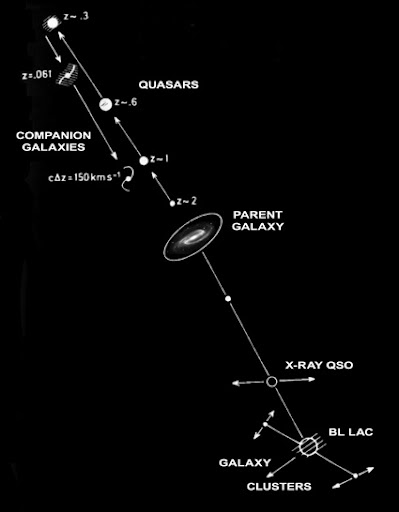
* Highly active galaxy
* Spurts out a high redshift quasar, "Not far from the center".
You my friend could be seeing the electrical birth of a new galaxy. It will be interesting to see this story progress, directions and positions of the 'super luminal micro-QSO', and if it's long lived.
M82 does show some similarities to Seyferts at it's nucleus, but the stars it produces are not long lived and are younger type stars, hence why it's called a 'star burst' galaxy.... are we seeing a galaxy teen-mother giving birth to premature midgets? who knows. Very interesting discovery. Definitely adding some great data to the story of galaxy evolution.
Here's the model for Arp's QSO birth from Seyfert (bear in mind M82 not a Seyfert, but everyone here just knows it's juiced up on current):
-
GaryN

- Posts: 2668
- Joined: Tue Apr 01, 2008 8:18 pm
- Location: Sooke, BC, Canada
Re: Mystery object moving too fast
The QSO is not a thing, it is an event, and is not subject to the speed limitation of mass. A result of wave/pulse propagation and interference, something like that. 
In order to change an existing paradigm you do not struggle to try and change the problematic model. You create a new model and make the old one obsolete. -Buckminster Fuller
-
Jarvamundo
- Posts: 612
- Joined: Fri Feb 05, 2010 5:26 pm
- Location: Australia
Re: Mystery object moving too fast
Also need to bear in mind how they would've calculated that 'super luminal' speed...
It would've been point-arc-seconds across the sky, over time, then one would need to ask did they use the QSO redshift distance to infer the distance? or did they use the M82 redshift distance? Much like how far you hold your thumb way from your face when measuring the moon.
Using the QSO redshift would yield a much higher apparent velocity, because it's billions of lightyears away, moving xx arc seconds across the sky.
Using the M82 redshift distance (parent) 12million light years, may preserve this object to be at sub-luminal velocities. (ie if we accept a component of the redshift is intrinsic)
These variables will make a BIG difference on the inferred speed of the object, what ever it may be. Now then stop and think how many past calculations and models will need to be adjusted with this 'intrinsic redshift' property in mind. If not redshift, what would become our measurement of distance, is this just too tricky for the world of standard BBT cosmology to face?
It would've been point-arc-seconds across the sky, over time, then one would need to ask did they use the QSO redshift distance to infer the distance? or did they use the M82 redshift distance? Much like how far you hold your thumb way from your face when measuring the moon.
Using the QSO redshift would yield a much higher apparent velocity, because it's billions of lightyears away, moving xx arc seconds across the sky.
Using the M82 redshift distance (parent) 12million light years, may preserve this object to be at sub-luminal velocities. (ie if we accept a component of the redshift is intrinsic)
These variables will make a BIG difference on the inferred speed of the object, what ever it may be. Now then stop and think how many past calculations and models will need to be adjusted with this 'intrinsic redshift' property in mind. If not redshift, what would become our measurement of distance, is this just too tricky for the world of standard BBT cosmology to face?
-
Jarvamundo
- Posts: 612
- Joined: Fri Feb 05, 2010 5:26 pm
- Location: Australia
Re: Mystery object moving too fast
well of course... just google m82 and quasar...
http://iopscience.iop.org/0004-637X/591/2/690
http://www.thunderbolts.info/tpod/2004/ ... rs-m82.htm
1... 2... 3... "surprize"!
http://iopscience.iop.org/0004-637X/591/2/690
http://www.thunderbolts.info/tpod/2004/ ... rs-m82.htm
1... 2... 3... "surprize"!
-
Jarvamundo
- Posts: 612
- Joined: Fri Feb 05, 2010 5:26 pm
- Location: Australia
Re: Mystery object moving too fast
"Man, that QSO is really Chippin!"

I wonder if their 'super-luminal' interpretation is based on this type of redshift-distance inferred calculation of the QSO.
Does Arp now have an early-stage velocity to play with.
I wonder if their 'super-luminal' interpretation is based on this type of redshift-distance inferred calculation of the QSO.
Does Arp now have an early-stage velocity to play with.
-
solrey

- Posts: 631
- Joined: Fri Jan 30, 2009 12:54 pm
Re: Mystery object moving too fast
Great visualization there Alex.
Go to the source, I always say.
Press Release from Royal Astronomical Society here.
Link to paper on arxiv.org
Discovery of an unusual new radio source in the star-forming galaxy M82: Faint supernova, supermassive blackhole, or an extra-galactic microquasar?
In the course of digging for the paper I found this little gem. M82 seems to be a case study for EU theory.
Mystery of twin quasar brightness revealed
Go to the source, I always say.
Press Release from Royal Astronomical Society here.
Link to paper on arxiv.org
Discovery of an unusual new radio source in the star-forming galaxy M82: Faint supernova, supermassive blackhole, or an extra-galactic microquasar?
So there was the sudden appearance of a compact radio source that appeared to maybe move at 4c for the first fifty days then was subsequently detected at its original position. Very curious. I'm leaning towards an initial superluminal propagation of a phase conjugate pulse wave through dusty plasma if the motion detected is genuine.The position of the new MERLIN source has been measured in each epoch relative to the position of the phase reference source and relative to other bright, static radio sources in M82, such as SN 2008iz, 41.95+57.5, 43.31+59.2 and 44.01+59.6. Over the first 50 days of monitoring, including 6 MERLIN and 3 VLBI epochs, the fitted position of the source shows evidence for east to west proper motion of ∼10±5 mas. This equates to an apparent proper motion of ∼0.2 mas day−1 , equivalent to an apparent superluminal motion of ∼4.2c at the distance of M82. Subsequent data from 29th June 2009 (58 day after 1st May 2009) onwards show the source position to be consistent with its initial position measured on 3rd May 2009. Thus, considering that the positional shift is at the limit achievable with these data the detection of any proper motion can only be considered as tentative at this early epoch.
In the course of digging for the paper I found this little gem. M82 seems to be a case study for EU theory.
Mystery of twin quasar brightness revealed
Variations in the brightness of the Q0957+561 quasar, also known as the “twin quasar” due to its duplicated image on Earth, are intrinsic to the entity itself and not caused by the gravitational effects of possible planets or stars from a far away galaxy. This is the conclusion of a study carried out by Spanish researchers resolving a mystery that has intrigued astronomers for the past 30 years.
“It seems the attractive hypothesis of a large population of dark objects with planetary mass in the galaxy’s halo has disappeared, since the variability found in our experiment is of intrinsic origin to the quasar”, commented Goicoechea. The researchers have confirmed that fluctuations in the brightness detected in image A were repeated 14 months later in Image B. If they had been caused by the gravity of planets or stars, the fluctuations in image A would not have been exactly replicated in image B.
They go on to invoke black hole accretion discs as the cause of the timing in the fluctuations between the two quasars. Or it could be like a pulse of energy traveling along a conductive path between them.To measure the brightness of the two images of the twin quasar, the astronomers used the robotic telescope ‘Liverpool’, located in La Palma (Canary Islands). The study focused on the analysis of the blue and red colours in the light, with the results showing that over the months the maximum width of the brightness varied around 10% in relation to the average. Those fluctuations were also observed in image B approximately 14 months after being detected in A.
“Today's scientists have substituted mathematics for experiments, and they wander off through equation after equation, and eventually build a structure which has no relation to reality"
Nikola Tesla
Nikola Tesla
-
Jarvamundo
- Posts: 612
- Joined: Fri Feb 05, 2010 5:26 pm
- Location: Australia
Re: Mystery object moving too fast
Thanks tim! (http://arxiv.org/pdf/1003.0994v1)
hmm m82 distance... so visualization does not apply in this instance, do they even get spectrums on these smaller microQSO's? ... hmm. Thanks for the paper... alot more clarity! Ta.
Very interesting to read that the apparent growth of the area of the source is also 'super luminal'. With typical super nova's expanding to 2mas, after 250 days ... this one is already out to 15mas.
Will be interesting to see the progress on this object, been alive for 9 months now....we'd expect phase conjugate pulse wave to split/spread at some point yeah?.... fascinating.
Here's a slideshow on micro-quasars... It's peppered with BH-explanations, but has some good historical and observational information on it.... wasn't really aware of some of the differences. M-QSO vs QSO etc.
http://www.mpa-garching.mpg.de/lectures ... chwabe.pdf
That second link is a gem indeed... lots to do in M82-EU!
hmm m82 distance... so visualization does not apply in this instance, do they even get spectrums on these smaller microQSO's? ... hmm. Thanks for the paper... alot more clarity! Ta.
Very interesting to read that the apparent growth of the area of the source is also 'super luminal'. With typical super nova's expanding to 2mas, after 250 days ... this one is already out to 15mas.
Will be interesting to see the progress on this object, been alive for 9 months now....we'd expect phase conjugate pulse wave to split/spread at some point yeah?.... fascinating.
Here's a slideshow on micro-quasars... It's peppered with BH-explanations, but has some good historical and observational information on it.... wasn't really aware of some of the differences. M-QSO vs QSO etc.
http://www.mpa-garching.mpg.de/lectures ... chwabe.pdf
That second link is a gem indeed... lots to do in M82-EU!
Who is online
Users browsing this forum: No registered users and 15 guests