How do you think heaven and earth?

Beyond the boundaries of established science an avalanche of exotic ideas compete for our attention. Experts tell us that these ideas should not be permitted to take up the time of working scientists, and for the most part they are surely correct. But what about the gems in the rubble pile? By what ground-rules might we bring extraordinary new possibilities to light?

Moderators: MGmirkin, bboyer

mrjacquel
Posts: 33
Joined: Wed May 05, 2010 10:51 am

Re: How do you think heaven and earth?

Unread post by mrjacquel » Thu Dec 09, 2010 5:55 pm

I have male family members who are good at polemics. Not really my thing. What do you think is the ultimate path to truth Mr Jacquel?
Now that is certainly a steep question, that normally I'd never be bold enough to venture an answer at. But, since you're just asking my humble opinion, I'll give it a brief try:

In my view, I must divide this question into two separate ones - one concerned with the path to truth and the other concerned with "ultimate" truth, or truth that is not intelligible to us, intellectually (i.e., the kind Watts was fond of talking about). The first is concerned with intelligible truths (we might say analytical ones) and concerns that which can be expressed by language and conventional human concepts - like causality. Rather, I should say that those are the tools of this type of understanding, which is the aim that science works at. This requires us to speak rationally and be precise with our language.

The latter, and I would say rarest type of truth is... well, there you go. That is precisely the issue with this arena - it is beyond the ability of our language to express it. If I am even right in calling it "truth" I can't say.

I would say that the path to these is not only wisdom, but the love of it (as the Greeks believed), good old fashion dialogue, the Socratic method of constant inquiry and the fortitude to question anything and everything and not be afraid to do so.

User avatar
JaJa
Posts: 344
Joined: Tue Nov 16, 2010 5:23 am

Re: How do you think heaven and earth?

Unread post by JaJa » Fri Dec 10, 2010 4:20 am

I find it very difficult to determine what "truth" is, the problem I have, I believe was highlighted very well by Watts' double blind game, indeed, what are "my" thoughts, but more so, who do my thoughts belong to, what are my alleged truths in this respect? From the moment I was born I consume information like a chocoholic consumes chocolate and the appetite is insatiable. I appeared to be "programmed" to watch and then imitate actions and behaviours, at least in the early years of my life. Bruce Lipton and others suggest pre-birth downloading in the womb but I think the "imitating" begins before this because I came with a template of information that was transferred from a combined total of 46 chromosomes.

As Watt's remarked, language is not my own. Or is it? Do I inherit language, or do I simply re-discover a process that has always been there... to be honest I think it is both. Without language what is the meaningful value of any-thing. From a conventional point of view I am born into a world defined by a language that is apparently not of my own making, this includes my thoughts, because I also think in the same language that I speak. However, my view is that I am not born into anything. I was born out of my mother, who was born out of her mother, who was born out of her... and so on.

Rather than look at the rarest type of truth, or that which we believe to be beyond the expression of language, I prefer to think of it along the lines of everything that can be expressed, has been already, there is nothing beyond language, only the “mystery” which we add to complicate matters. But even that mystery has been defined by the language we know. Who knows, perhaps complexity gives us a sense of cleverness. Beyond expression is beyond language itself and beyond language what value has any-thing? Will we one day discover another kind of language to quantify this something else we can't yet express, what kind of language would it be, would it be different to the basic words and pictures we already understand... and why?

I inferred previously in this thread that access to knowledge was attainable. It is my view, and it still is that a person can gain access to information through direct (meditation) insight and indirect (instinctive) intuition. In both cases a person is not gaining something new, simply remembering something that has always been there, much like a blind man undergoing corrective surgery to give them a return of sight. Such insights may come as passing thoughts, eureka moments, an itch that you can’t scratch, or as something that you can’t quite put your finger on. How many times do we ignore, dismiss, or fail to understand something that we put down to general weirdness?

Personally I don’t think there is knowledge of a life after death because this is it. Death is simply a state of mind, a mechanism in which to forget everything about who and what we are – but that would be for another thread because I have rambled enough about my own humble opinions...

JJ
Omnia in numeris sita sunt

JohnMT
Posts: 99
Joined: Fri Dec 12, 2008 5:52 am

Re: How do you think heaven and earth?

Unread post by JohnMT » Fri Dec 10, 2010 4:24 am

Hi JaJa,

You wrote:
@JohnMT any chance you could remember that link to Thornhill and Genesis, maybe that was what the OP was referring to and I would be happy to discuss that...
It was not so much a link, but a question that was asked of Wal during a Conference in the year 2000 ref http://www.sis-group.org.uk/talk0010.htm

Ten years ago!

The conference was filmed (due no doubt to Halton Arp's lecture), but I haven't seen the footage as yet.

Perhaps there are links etc that relate to this subject and if so, I also would be happy to discuss them.

Cheers.

User avatar
JaJa
Posts: 344
Joined: Tue Nov 16, 2010 5:23 am

Re: How do you think heaven and earth?

Unread post by JaJa » Fri Dec 10, 2010 8:31 am

Hi JohnMT

Wow, 10 years ago, I wonder how much of Wal Thornhill's thinking has changed in that time - if anything?

Isn't the basic premise for Gap Theory a young earth?

JJ
Omnia in numeris sita sunt

JohnMT
Posts: 99
Joined: Fri Dec 12, 2008 5:52 am

Re: How do you think heaven and earth?

Unread post by JohnMT » Fri Dec 10, 2010 11:39 am

Hi JaJa,
Wow, 10 years ago, I wonder how much of Wal Thornhill's thinking has changed in that time - if anything?

Isn't the basic premise for Gap Theory a young earth?
I would say that over the past ten years or so, Wal's thinking has been somewhat modified as new discoveries have been made.
The basic tenets of the EU theory however, remain more or less the same.

I've heard Wal speak on many occasions, the most recent being in July this year ref http://www.sis-group.org.uk/wallace-tho ... c-universe

During that lecture his views on Matter, Mass, Gravity and the Electric Force were very interesting and he referred to the theories of Ralph Sansbury, but not in too much detail due to the time factor (the building had to be vacated by 1700)

With respect to the Gap Theory, much has been written over the years and there are several different versions that deal with an 'Old Earth' and/or a 'Young Earth' and of course Genesis 1:1 and Genesis 1:2 give no details whatever except to suggest there might have been an age 'Gap' between the two verses'

There is an interesting Biblical quote (among many others) in respect of this Gap Theory ref:

2 Peter 3:5-7 (King James Version)

5"For this they willingly are ignorant of, that by the word of God the heavens were of old, and the earth standing out of the water and in the water:"

6"Whereby the world that then was, being overflowed with water, perished:"

7"But the heavens and the earth, which are now, by the same word are kept in store, reserved unto fire against the day of judgment and perdition of ungodly men."

Perhaps the Earth was once inhabited by certain Beings that existed for an indeterminate length of time, but which eventually perished in some cataclysm, the result being a now devastated Earth ref Genesis 1:2 ie

"And the earth was without form, and void; and darkness [was] upon the face of the deep. And the Spirit of God moved upon the face of the waters."

Big subject this, but if there is an element of truth in the conjecture, it could explain why everywhere we look in the Solar System and particularly here on the Earth, we see catastrophe and devastation in great abundance, which to my mind fits within the basic premises of the EU Theory.

Cheers

mrjacquel
Posts: 33
Joined: Wed May 05, 2010 10:51 am

Re: How do you think heaven and earth?

Unread post by mrjacquel » Fri Dec 10, 2010 12:28 pm

JaJa,

Interesting to read your thoughts. I don't think you realize how heavy your inquiry is, which is a good thing! And by "heavy" the only synonymn I can think of is "dense," (to describe the current subjects of your philosophizing) meaning that there's a lot to it. I would encourage you to do whatever it is about philosophy that you enjoy most (like consuming information insatiably).

If I may, I think the concept of "truth" is a tricky one to grapple with for any good philosopher and that this is why you struggle yourself to make sense of this illusive concept. In the Socratic dialogues, one notices that Socrates' attempt to find universal definitions for fundamental concepts and virtues like truth, beauty, justice, etc., were more often unsuccessful. I have a thesis for this problem and that is that these truths are not intelligible (if they even exist). Definitions are inherently circular, and how we choose to define something (i.e., when we stop searching for more definitions and settle for the one we have) is arbitrary as well as a function of context... by which I mean that a particular concept can only be defined according to context we wish to use it in (scientific, philosophic, etc.). This would make universal "truths" difficult - no, impossible - to come by. Socrates' wisest statement remains, to this day, "All I know is that I know nothing."

As for "truth" in itself - some members of this forum are right to put the word in quotation marks (I think I saw that earlier). I find that I must agree with Popper and conduct all my philosophizing based on the assumption that it is there, but there is no way humanly possible to know whether we've got it or not. Thus, all we can do is seek to eliminate our errors, instead of validate ourselves - because truth is impossible to detect, but errors are not. This is why criticism of other doctrines is so fundamental to the growth of knowledge. We might never know if something is true or not, but we don't need to. What we CAN realistically achieve is a closer approximation to truth through the procedural elimination of errors.

Lastly, I obviously agree that any knowledge of life-after-death is even more difficult - again, impossible - to come by. This is why I tend to treat with criticism anyone who claims they've achieved it, or appears to. (Religion being the most immediate and obvious example). Socrates himself knew he had no knowledge of this, and upon his death sentencing even weighed the potential options because, as far as he knew, each one could be potentially true. This is why I find it contemptable when someone claims to "know."

User avatar
JaJa
Posts: 344
Joined: Tue Nov 16, 2010 5:23 am

Re: How do you think heaven and earth?

Unread post by JaJa » Sat Dec 11, 2010 3:02 am

Hi Mr Jacquel

Not wishing to derail this particular thread and get it locked (although I’m not sure it ever got off the ground as the OP seems to have vanished) I will if I may offer a response to your consideration of my ramblings.

I do realise the vastness of the enquiry but I don’t give myself to the idea that some things are impenetrable. Enough obstacles are erected in our psyche by those around us and I don’t see the benefit of adding our own and further limiting boundaries.

The difference between the greatest athletes in the world, such as Michael Johnson and Michael Phelps, to others in the same field wasn't/isn't that they have been blessed with a greater ratio of type II(a)/type II(b) to type I (fast/slow twitch) muscle fibres - but it is also the Mind-set they adopted. There was/is a greater sense of self-belief in their own ability. This is why they won multiple World Championships.

With the greatest respect to Socrates, I don’t agree with this statement “all I know is that I know nothing” because it is an oxymoron in my Mind, a contradiction in terms, but that is just my personal opinion. ;)
I find that I must agree with Popper and conduct all my philosophizing based on the assumption that it is there, but there is no way humanly possible to know whether we've got it or not
I agree with you in the first part of this statement but not the second. If I base my potential on the assumptions of others then I have limited myself to the potential of their point-of-view.
Lastly, I obviously agree that any knowledge of life-after-death is even more difficult - again, impossible - to come by
Do you assert this on what you have learned you can "know" or do you assert this on what you "know" you can learn?

Thank you for the conversation, it's enjoyable :D

JJ
Omnia in numeris sita sunt

User avatar
JaJa
Posts: 344
Joined: Tue Nov 16, 2010 5:23 am

Re: How do you think heaven and earth?

Unread post by JaJa » Sat Dec 11, 2010 4:48 am

Hey John

I have missed Mr Thornhill's speeches which I sorely regret, I was hoping that his latest speech would be recorded.

I am at a distinct disadvantage because although my Mother's side of the family is deeply religious (although my Mother not so much these days) my knowledge and understanding of the bible is very limted because it wasn't something that was forced upon us as children.

My understanding of the "old earth" theory is supposed to be supported by established dating methods, although I understand there is some dispute about carbon dating etc. As for the "young earth" theory, is it EU theory that it may have been ejected from a gas giant and electrically etched and has since experienced catastrophic encounters within an unstable solar system? Is there any literature about the age of earth according to EU do you know?
Perhaps the Earth was once inhabited by certain Beings that existed for an indeterminate length of time, but which eventually perished in some cataclysm, the result being a now devastated Earth ref Genesis 1:2 ie

"And the earth was without form, and void; and darkness [was] upon the face of the deep. And the Spirit of God moved upon the face of the waters."
As in the Golden age perhaps - although how does that make it a "young" earth? I can see how that quote could be interpreted as the end/beginning of something rather than the ultimate creation point?
Big subject this, but if there is an element of truth in the conjecture, it could explain why everywhere we look in the Solar System and particularly here on the Earth, we see catastrophe and devastation in great abundance, which to my mind fits within the basic premises of the EU Theory.
A lot bigger than I first realised. Yes there is evidence of catastrophe, i.e. physical/electric (scars of the earth) and that which is recorded by history. However, didn't I read somewhere that D Talbot thought the last catastrophe may have happened 10,000 years ago (I could be wrong). If that's the case what caused the great flood and exodus recorded in the bible - a mini catastrophe?

Great topic John :D

JJ
Omnia in numeris sita sunt

mrjacquel
Posts: 33
Joined: Wed May 05, 2010 10:51 am

Re: How do you think heaven and earth?

Unread post by mrjacquel » Sun Dec 12, 2010 12:19 am

I do realise the vastness of the enquiry but I don’t give myself to the idea that some things are impenetrable. Enough obstacles are erected in our psyche by those around us and I don’t see the benefit of adding our own and further limiting boundaries.
Well that's certainly the appropriate attitude to take in the love/pursuit of knowledge. And yes, mind-set plays a huge role in anything worth being good at.
With the greatest respect to Socrates, I don’t agree with this statement “all I know is that I know nothing” because it is an oxymoron in my Mind, a contradiction in terms, but that is just my personal opinion.
About that you're absolutely right (but such is the language of greater philosophical truths, I've found ;) ). Watts' paradoxical language is a perfect example of this.
I agree with you in the first part of this statement but not the second. If I base my potential on the assumptions of others then I have limited myself to the potential of their point-of-view.
I would likewise encourage you NOT to base your potential on the assumptions of others, not even mine. However, in your pursuits, you will undoubtedly find common ground (as well as common limitations) with other philosophers. These limits, I maintain, are just a consequence of being human in the first place. But by all means, don't take my word for it. :)
Do you assert this on what you have learned you can "know" or do you assert this on what you "know" you can learn?
On basis of what I've learned it is within our human capacity to know (rationally). Emphasis on the word "rationally." Do not misinterpret me as asserting that the human condition limits our potential experience or enlightenment or whatever you want to call it. What we ARE limited with, I assert, is the capacity of rationalism; that is, to speak rationally of and describe certain truths that (as Watts maintains) must be directly experienced but can only be linguistically expressed in paradoxical (thus, irrational), mythological or metaphorical terms.

And no, thank you!

User avatar
JaJa
Posts: 344
Joined: Tue Nov 16, 2010 5:23 am

Re: How do you think heaven and earth?

Unread post by JaJa » Sun Dec 12, 2010 8:21 am

Hi Mr Jacquel
These limits, I maintain, are just a consequence of being human in the first place. But by all means, don't take my word for it.
I don't believe limitation is a consequence of being human but more like a consequence of the attitudes and ideals that one is born into, which is further compounded by limited education systems, selective media reporting and being surrounded by good old fashioned ignorance - which can sometimes rub off... :D
What we ARE limited with, I assert, is the capacity of rationalism; that is, to speak rationally of and describe certain truths that (as Watts maintains) must be directly experienced but can only be linguistically expressed in paradoxical (thus, irrational), mythological or metaphorical terms
Can I ask Sir, do you believe Life is rational and logical :?

JJ
Omnia in numeris sita sunt

JohnMT
Posts: 99
Joined: Fri Dec 12, 2008 5:52 am

Re: How do you think heaven and earth?

Unread post by JohnMT » Sun Dec 12, 2010 9:01 am

Hi JJ,
I have missed Mr Thornhill's speeches which I sorely regret, I was hoping that his latest speech would be recorded.
Wal's lecture was recorded in both Audio and Video DVD.
The Audio is available now, but there is no release date for the DVD as yet.
Ref: http://www.sis-group.org.uk/wallace-tho ... c-universe
(Click on 'membership' which will lead you to the SIS Book Service)
I am at a distinct disadvantage because although my Mother's side of the family is deeply religious (although my Mother not so much these days) my knowledge and understanding of the bible is very limted because it wasn't something that was forced upon us as children.
One doesn't have to be 'religious' to read and understand the Bible
My understanding of the "old earth" theory is supposed to be supported by established dating methods, although I understand there is some dispute about carbon dating etc. As for the "young earth" theory, is it EU theory that it may have been ejected from a gas giant and electrically etched and has since experienced catastrophic encounters within an unstable solar system? Is there any literature about the age of earth according to EU do you know
For the most part, ALL dating methods are unreliable, especially carbon dating.

As far as I am aware, 'Evolutionism vs Creationism' is not debated within EU circles, nor do I know of any relevant literature on these subjects within the EU fraternity.
I think it is generally understood that our Earth was an 'offshoot' of the original Red Dwarf Star (Super-Saturn?), prior to the capture of this system within the Sun's domain.
Thereafter, differences of electrical potential and electrical over-stress between these systems initiated the sequence of break-ups and planetary catastrophes.
As in the Golden age perhaps - although how does that make it a "young" earth? I can see how that quote could be interpreted as the end/beginning of something rather than the ultimate creation point?
According to the EU Saturn Theory, the Earth was already formed and enjoying a 'Golden Age' in those ancient times between Genesis 1:1 and Genesis 1:2.
The 'Break-up' occurred at Genesis 1:3 - 'Let there be light...'
Prior to this, the stars were not seen.
A lot bigger than I first realised. Yes there is evidence of catastrophe, i.e. physical/electric (scars of the earth) and that which is recorded by history. However, didn't I read somewhere that D Talbot thought the last catastrophe may have happened 10,000 years ago (I could be wrong). If that's the case what caused the great flood and exodus recorded in the bible - a mini catastrophe?
I think the 10,000 years ago figure refers to the Capture and/or Break-Up of the Saturnian system, but I may be wrong.
To my mind, the 'great flood' or, 'Flood of Noah' was caused by the Nova or 'flare-up' of Saturn as briefly described in Velikovsky's book 'Mankind in Amnesia' page 97 'THE FEAST OF LIGHT'

The Exodus catastrophes occurred around 1450 BC, when the Earth passed through the tail parts of the then cometary-looking proto-Venus...and repeated to a lesser extent some 52 years later.
Great topic John
I concur,

Cheers

User avatar
JaJa
Posts: 344
Joined: Tue Nov 16, 2010 5:23 am

Re: How do you think heaven and earth?

Unread post by JaJa » Sun Dec 12, 2010 2:10 pm

Hi John

Thanks for the link to the audio - that will go on my list of to do's :D
One doesn't have to be 'religious' to read and understand the Bible
I meant in terms of our discussion now, I feel I would have a lot more to offer (because I would be knowleagable) if I had picked up the bible as a child, but for some reason, it never appealed to me. Perhaps it should go on the to do's as well 8-)
For the most part, ALL dating methods are unreliable, especially carbon dating.
Yes I thought as much... I still don't think I can bring myself to go for a 6000 year old beginning though... :lol:
I think it is generally understood that our Earth was an 'offshoot' of the original Red Dwarf Star (Super-Saturn?), prior to the capture of this system within the Sun's domain.
Thereafter, differences of electrical potential and electrical over-stress between these systems initiated the sequence of break-ups and planetary catastrophes.
So... a million dollar question for me would be - has this happened once or is it part of an inherent cycle of catastrophe's... or are we literally at the mercy of whatever's out there as our galaxy floats through space (we can float through space if we are part of a larger connected circuit right)?

If Venus was ejected as a proto-planet there is some similarity between mother ejecting baby, at a superficial level at least, if so, Venus should be evolving? Also, how would one determine if a gas giant was "pregnant" or about to spit something out, would there, like a human counterpart, be anatomical changes taking place prior to the birthing, something that we might be able to detect with modern technology?

Thanks for the Velikovsky pointer...

JJ
Omnia in numeris sita sunt

mrjacquel
Posts: 33
Joined: Wed May 05, 2010 10:51 am

Re: How do you think heaven and earth?

Unread post by mrjacquel » Sun Dec 12, 2010 10:07 pm

I don't believe limitation is a consequence of being human but more like a consequence of the attitudes and ideals that one is born into, which is further compounded by limited education systems, selective media reporting and being surrounded by good old fashioned ignorance - which can sometimes rub off...
Powerful factors, to be sure. When I refer to the limits of human mind, I mean our ability to transcend our perceptions and conceptions. Immanuel Kant held that the human mind is incapable of going beyond experience to obtain a knowledge of ultimate reality, because pure ideas can't provide us a bridge to objective reality. He tended to distinguish between things of perception and thing "of themselves," a common theme in Oriental thought.

I add, personally, that if there is an ultimate reality, it can be connected to, but only through meditative experience. This is where rationalism cannot go. Hence, objective, ultimate, reality is unintelligible and in that precise sense (and that sense only) unknowable. But it is not "unexperienceable," if you will. I am careful when I speak in this way that I not be misinterpreted as a spiritualist or mysticist, because I feel that spiritualists might immediately take from this permission to interpret me as someone who contradicts himself, or that this is evidence that there is a spiritual realm where we go to when we die. Although I don't completely dismiss it, I'm not convinced of it yet either.
Can I ask Sir, do you believe Life is rational and logical
I will say that Life, as I understand the way you're using it, is an abstract concept and so it cannot possess qualities of rationality or irrationality. Hope you find this helpful.

User avatar
JaJa
Posts: 344
Joined: Tue Nov 16, 2010 5:23 am

Re: How do you think heaven and earth?

Unread post by JaJa » Mon Dec 13, 2010 6:06 am

Hi Mr Jacquel

This discussion is most interesting :D
When I refer to the limits of human mind, I mean our ability to transcend our perceptions and conceptions. Immanuel Kant held that the human mind is incapable of going beyond experience to obtain a knowledge of ultimate reality, because pure ideas can't provide us a bridge to objective reality.
On this I agree. I have to get past the boundaries of Immanuel Kant as well as my own self-imposed limitations in order to transcend subjectively and objectively set perceptions and conceptions. I don’t think the Mind is incapable of experiencing knowledge of the ultimate reality, I believe we dip in and out of it all the time. When I consider this experience of reality I consider there to be two states-of-Mind based on a simple principle. As Milo Wolff said;
“A particle entirely alone in the universe could not have dimensions of time, length, or mass. These dimensions are meaningless without the existence of other matter because dimensions can only be defined by comparison with other matter”
I attribute the same to self-awareness, i.e. in order for one-thing to be aware of what it is – there has to be a minimum of two reference points. In these terms I can state that the two points of awareness are the subconscious and conscious states-of-Mind, the basis for all dual aspects of nature, that which we attribute to yin-yang.

The subconscious would be Bohm’s implicate order - whereas consciousness would be the explicate wave of experience that breaks momentarily and then folds back into the sea. The sea/implicate order/subconscious is recognised as many different things, such as the Askashic record, the information field, zero-point energy etc.

Strip away colour of skin, eyes, shape of body, sexual orientation and everything else we associate with being human and we can easily indentify two inherent stabilities in our condition, that is conscious, and subconscious awareness. We share these fundamental attributes and rather than looking at it from a detached point-of-view and saying there are 6 billion separate entities ALL experiencing seperate conscious and subconscious states of Mind I prefer to think of it as 6 billion waves manifesting from one eternal subconscious sea.

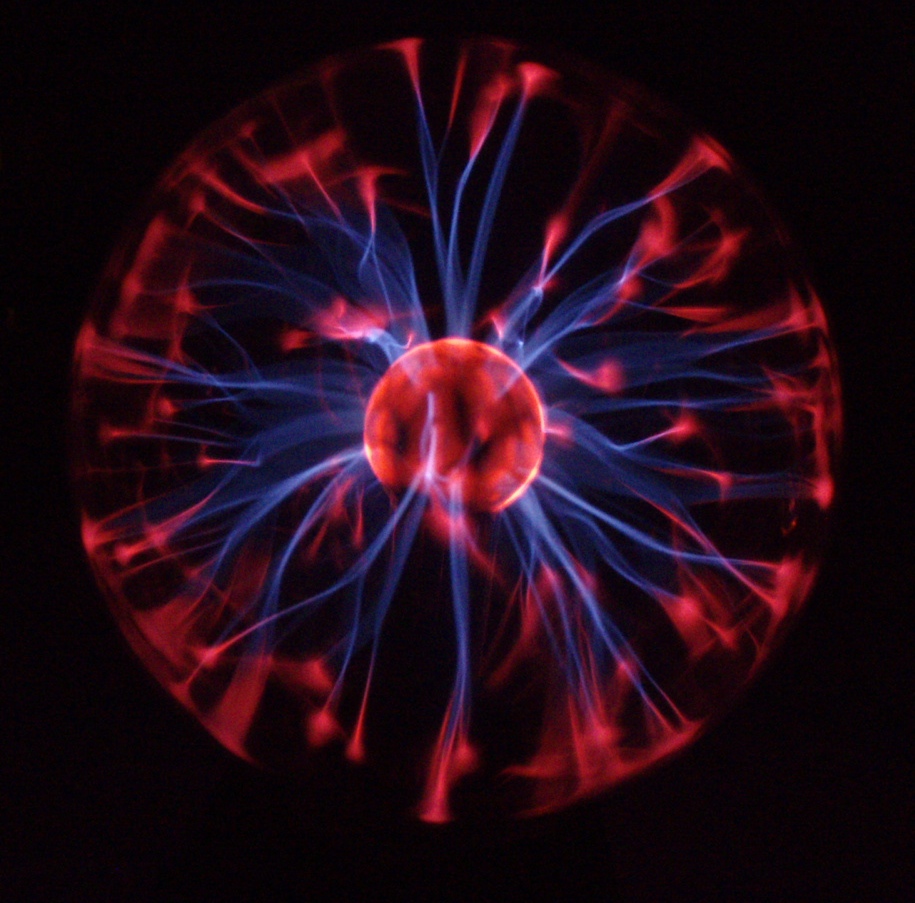
I think I have seen the analogy made on these forums before with the plasma globe;

http://upload.wikimedia.org/wikipedia/c ... ocurio.jpg

In this particular analogy the plasma ball is the subconscious and each individual strand and focus point is a wave of consciousness merely extending from the original source.
I am careful when I speak in this way that I not be misinterpreted as a spiritualist or mysticist, because I feel that spiritualists might immediately take from this permission to interpret me as someone who contradicts himself, or that this is evidence that there is a spiritual realm where we go to when we die. Although I don't completely dismiss it, I'm not convinced of it yet either.
Don't worry... your secret is safe with me :lol:. Back on a serious note I don't regard myself as spiritual. The realm that we seek, as I said earlier, I believe, is something we dip back in and out of during sleep - the subconscious.

This is where ALL ideas, thoughts and inspirations come from imho, this universal sea of everything, perhaps this explains why we resonate so much with each others thoughts and ideas, because they are unfolding from the same source. We all have ideas, we all think, we all have moments of inspiration. I can look at that and say this happens to me seperately from everyone else, or I can look at that and say I am rooted in one universal subconscious from which all thought and inspiration unfolds.

JJ
Last edited by JaJa on Mon Dec 13, 2010 6:43 am, edited 1 time in total.
Omnia in numeris sita sunt

JohnMT
Posts: 99
Joined: Fri Dec 12, 2008 5:52 am

Re: How do you think heaven and earth?

Unread post by JohnMT » Mon Dec 13, 2010 6:41 am

Hi JJ,

You wrote:
I meant in terms of our discussion now, I feel I would have a lot more to offer (because I would be knowleagable) if I had picked up the bible as a child, but for some reason, it never appealed to me. Perhaps it should go on the to do's as well
I agree with your sentiments.
Never mind.
There is no time like the present however.
The Bible contains a good deal of relevant information with regard to catastrophes and other occurrences.

You wrote:
Yes I thought as much... I still don't think I can bring myself to go for a 6000 year old beginning though...
I think its all a matter of interpretation.
However, Robert Gentry's 'Polonium Halos' do speak of a sudden creation event with respect to the formation of Granite.

You wrote:
So... a million dollar question for me would be - has this happened once or is it part of an inherent cycle of catastrophe's... or are we literally at the mercy of whatever's out there as our galaxy floats through space (we can float through space if we are part of a larger connected circuit right)?
A good question and to date, no-one has a definitive answer.
I would say for the moment that our current interstellar environment does appear to be relatively stable, although that could change overnight ref Don Scotts explanation http://www.electric-cosmos.org/hrdiagr.htm
Electric Star Evolution
In the Electric Star hypothesis, there is no reason to attribute youth to one spectral type over another. We conclude that a star's location on the HR diagram only depends on its size and the electric current density it is presently experiencing. If, for whatever reason, the strength of that current density should change, then the star will change its position on the HR diagram - perhaps, like FG Sagittae, abruptly. Otherwise, no movement from one place to another on that plot is to be expected. And its age remains indeterminate regardless of its mass or spectral type. This is disquieting in the sense that we are now confronted by the knowledge that our own Sun's future is not as certain as is predicted by mainstream astronomy. We cannot know whether the Birkeland current presently powering our Sun will increase or decrease, nor how long it will be before it does so.
You wrote:
If Venus was ejected as a proto-planet there is some similarity between mother ejecting baby, at a superficial level at least, if so, Venus should be evolving? Also, how would one determine if a gas giant was "pregnant" or about to spit something out, would there, like a human counterpart, be anatomical changes taking place prior to the birthing, something that we might be able to detect with modern technology?
I suspect that Venus is cooling down.
Velikovsky wrote a paper on this subject and suggested that a series of simple Bolometric measurements be carried out to prove his case ref 'Is Venus' Heat Decreasing' (1966)
In fact Velikovsky describes this as a 'crucial test' of his theory.
"Crucial" meaning "decisive"!...and that on this one test alone, if proven wrong, Velikovsky would "rest his case"
I am astonished that to date, some 44 years later, these measurements do not appear to have been made along the lines that Velikovsky suggested.
Carl Sagan had a stab at it in his book 'Scientists Confront Velikovsky' and provided a suitable graph as a measure of proof that Velikovsky was wrong.
The measurements however, were to be taken at "successive synodic periods" where they would be uniformly spaced, but they were not, hence Sagans sources were purey random and the results a complete hash.

I suspect that perhaps these Bolometric measurements have in fact been taken in complete accord with Velikovsky's suggestions and have proven to be correct, in that Venus' heat IS decreasing, but the results cannot made public due complete embarrassment in high academic circles.

That large planets like Jupiter, Saturn, Uranus or Neptune might as you say, display "anatomical changes taking place prior to the birthing, something that we might be able to detect with modern technology?" is quite feasible in my view.
In the case of Jupiter for instance, we have a huge planet that rotates once on its axis in under 10 hours!
I just can't believe that this condition has been apparent for around 4-5 billion years, so we are told.
The other 'gas giants' also display similar properties by their own nature, so something it seems, appears to be 'brewing'.
That a rogue brown dwarf, a rogue planet or asteroid might enter the Sun's domain are other possibilities too.

For the moment at least, all appears to be 'normal', but we shall have to just wait and see.

Cheers.

Locked

Who is online

Users browsing this forum: No registered users and 18 guests