Stars Not Visible in Space?

Beyond the boundaries of established science an avalanche of exotic ideas compete for our attention. Experts tell us that these ideas should not be permitted to take up the time of working scientists, and for the most part they are surely correct. But what about the gems in the rubble pile? By what ground-rules might we bring extraordinary new possibilities to light?

Moderators: MGmirkin, bboyer

Locked
Lloyd
Posts: 4433
Joined: Fri Apr 04, 2008 2:54 pm

Stars Not Visible in Space?

Unread post by Lloyd » Thu Apr 21, 2011 10:14 am

Aardwolf said: Because we have very little, if any, evidence that it is possible to see stars in space.
I replied: As I said before, the fact that Mars, the Moon, Venus, the Sun etc look the same colors in photos from space and from naked-eye observations on Earth, seems to me to prove entirely that space transmits visible light, as well as other frequencies. It's only the matter of shutter speed that accounts for the frequent absence of stars in space photos. I don't see any credibility in the suspicion that space doesn't transmit visible light....
Aardwolf replied on Thu Apr 21, 2011 7:56 am: Not sure that anyone stated the visible light doesn't travel in space. Obviously visible light only photos exist of planets and moons. It just the stars that we have no evidence for.
- The Voyager images of the solar system are the most notable. Images that required very long over-exposure to see Uranus and Neptune yet not a single star was picked up in the field. The exposures were so long the images were smeared due to motion. Surely there should have been thousands of stars picked up. Uranus and Saturn are seen just as well as stars from Earth yet Voyager needed very long exposures to pick them out becasue they were so dim from its increased distance, yet not a single star was picked up. Stars would not have dimmed becasue another 40 AU would be irrelevant to their brightness. It doesn't make any sense.
- I'm not stating the stars are not there, but maybe visible light is shifted over extreme distances. I'm sure that could be relevant to distance measurements and probably many other measurements.
Sparky replied on Thu Apr 21, 2011 9:09 am: well, as i stand on earth, the stars appear to be in the sky, so i don't know how they could be a thousand times closer... :lol:
- what did i miss?..why can't we see the stars when viewed from the moon?...is there photon excitation of our atmosphere which produces secondary emissions which we see as stars? :oops:
- handicapped by lack of highly technical training, average or below I.Q., and the technology that i am using , a dell gx 1 w/98se @ 500mhz on a dial up isp. So links to videos are not an argument with me. (:
* How about discussing the issue here, instead of in the other thread?

User avatar
GaryN
Posts: 2668
Joined: Tue Apr 01, 2008 8:18 pm
Location: Sooke, BC, Canada

Re: Stars Not Visible in Space?

Unread post by GaryN » Thu Apr 21, 2011 1:35 pm

- what did i miss?..why can't we see the stars when viewed from the moon?...is there photon excitation of our atmosphere which produces secondary emissions which we see as stars?
Something like that, I'd say.

@Aardwolf
The Voyager images of the solar system are the most notable. Images that required very long over-exposure to see Uranus and Neptune yet not a single star was picked up in the field. The exposures were so long the images were smeared due to motion. Surely there should have been thousands of stars picked up. Uranus and Saturn are seen just as well as stars from Earth yet Voyager needed very long exposures to pick them out becasue they were so dim from its increased distance, yet not a single star was picked up. Stars would not have dimmed becasue another 40 AU would be irrelevant to their brightness. It doesn't make any sense.
That is the most telling evidence I think, that the long exposure to pick up the planets
should have resulted in seeing many stars too. The sensitivity of some of the CCDs they use
is such that even a very short exposure should pick up stars.
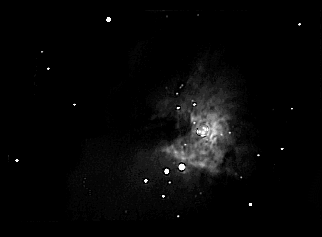
This guy has some interesting images from rather low-tech equipment.
Maybe NASA should hire him.
Real time (ONE frame!) image of M42
Mintron Camera at ETX-90 Prime focus

Image
Main page:
http://www.k3pgp.org/110703.htm

I'd like to see what one frame, using this device, would show
from the ISS. Why can't we see just one image of stars from the ISS
taken with such a cheapo setup?
I'm not stating the stars are not there, but maybe visible light is shifted over extreme distances. I'm sure that could be relevant to distance measurements and probably many other measurements.
Soething along these lines is how 'star' light is generated , and how it travels
in the vacuum. It is not, IMO, shifted. It travels as a quasi-planewave in the far UV,
and X-ray energies, and needs our atmosphere(ionosphere) to convert it to visible,
or in space it requires gratings. I think Xavier Borg just about has it figured.
Image
http://www.blazelabs.com/f-u-photons.asp
Image
Radiators on a spherical object.
http://en.wikipedia.org/wiki/File:Mars_xray_420.jpg
In order to change an existing paradigm you do not struggle to try and change the problematic model. You create a new model and make the old one obsolete. -Buckminster Fuller

Lloyd
Posts: 4433
Joined: Fri Apr 04, 2008 2:54 pm

Re: Stars Not Visible in Space?

Unread post by Lloyd » Thu Apr 21, 2011 5:07 pm

Are Stars Magnified?
* Well, I didn't think I'd have any more to say in this thread for a while, but, if it's true that there are few, if any, images of stars from space, I know of another possible reason. It may be that the atmosphere, which is spherically shaped, magnifies objects outside the atmosphere, as a spherical glass does.
* I first heard of that idea in 1975, when I first read a spiritual book, called Oahspe. It has a section, called Cosmogony and Prophecy, and somewhere in that section, it mentioned a number of supposedly wrong ideas in conventional science. One of its claims is that objects beyond the atmosphere are magnified by it and would be very hard to see otherwise. It claims that even the Sun would look much smaller.
* I had considered that book possibly correct on scientific matters until about 1995, when it started to appear that the book had a number of flaws. Most of its science claims seem rather esoteric and rather complex, so I had decided at that time that it was probably nonsense, though I never made a definite decision about that.
* I just looked it up on the net and it wasn't hard to find. It's at http://oahspestandardedition.com/OSE_38c.html and here's the statement:
Without the earth's atmospherean lens, man could not even see the moon, nor stars40; and the sun itself would seem like a pale red star.
* Someone has apparently gone through the book to find evidence in support of its claims.
* Anyway, I thought the idea is probably worth mentioning under the circumstances.

User avatar
nick c
Site Admin
Posts: 2483
Joined: Sun Mar 16, 2008 8:12 pm
Location: connecticut

Re: Stars Not Visible in Space?

Unread post by nick c » Thu Apr 21, 2011 7:01 pm

I find it hard to believe that this topic still has legs.
A recap....
The proposition that stars are not visible from space has been falsified in the image from the Mercury Messenger posted by Fosburn:
http://messenger.jhuapl.edu/gallery/sci ... tretch.png
I emailed NASA asking if these were indeed stars and received this reply (which was already posted on a related thread):
Indeed, Nicholas, those are stars.

Mike CarlowiczEditor - NASA Earth Observatory - http://earthobservatory.nasa.gov774-413-5168 (home office) and 508-566-2620 (cell)michael.j.carlowicz@nasa.gov

The fact that stars do not appear in many Nasa images (such as Moon photos) is explained by the necessities of photography, specifically exposure times required for bright subjects (the lunar landscape, astronauts, spacecraft, the Earth, etc.) versus exposure times required for dim subjects (such as stars). Images of stars are not that easy to obtain, even on Earth, they are very faint objects.
In the Messenger image notice how the Earth/Moon are greatly overexposed. If they were properly exposed, then most if not all, of the stars would not be bright enough to appear in the image.

Starbiter also posted this photo of stars above a spectacular aurora:
http://www.heraldsun.com.au/news/astron ... 5882755386
The viewpoint of the photo is above the aurora and looking down at it, the exposure is adequate to show stars, the nightside of Earth is below.

This Nasa site tells of the use of celestial navigation available to astronauts on the voyage to the Moon:
http://er.jsc.nasa.gov/seh/navigate.htm
HOW APOLLO 17 NAVIGATED
Celestial Navigation
untitled1.jpg
untitled1.jpg (2.81 KiB) Viewed 10543 times
The above picture represents the science of celestial navigation used by Apollo astronauts to reach the Moon. Notice the spaceship rocketing through the cosmos (the moving flash of light) with the field of star markers in the background. The lunar landing program employed 37 stars as guides for spacecraft navigation.Their prescribed position is so predictable and constant that a spaceship could journey hundreds of thousands of miles and land within hundreds of feet of a desired lunar landmark.
untitled2.jpg
Apollo Astronaut Sighting Star with Space Sextant

Despite the accomplishments of space age navigation, many of the principles and instruments used date back to centuries prior to Columbus's journey to the New World. These primitive instruments employed the stars, planets, Moon, and the Sun in the same fashion that Gene Cernan and his crew did.

highlight added
They must be able to see stars while in space in order to use this device, no?

Nick

User avatar
GaryN
Posts: 2668
Joined: Tue Apr 01, 2008 8:18 pm
Location: Sooke, BC, Canada

Re: Stars Not Visible in Space?

Unread post by GaryN » Thu Apr 21, 2011 9:12 pm

I find it hard to believe that this topic still has legs.
Lot's of legs, I think.
The proposition that stars are not visible from space has been falsified in the image from the Mercury Messenger posted by Fosburn:
I answered that in the other thread by saying I believe that image was from
the MASCS device. It is not an overexposed visible light image, and if you
compare it with the spectroscope images from the Apollo 16 FUVC device, in
spectroscope mode, you see the similarity.
Image
Starbiter also posted this photo of stars above a spectacular aurora:
I answered that one too. They are looking through the ionosphere. That is
what makes the stars visible to us on Earth.
They must be able to see stars in order to use this device, no?
"We were never able to see stars from the lunar surface or on the daylight side of the moon by eye without looking through the optics” ~ Neil Armstrong. Apollo 11
The optics were a grating based device. You can see one wavelength, the stars would
appear white, as they do through the spectroscope.
Navigation during the Apollo missions was conducted almost entirely by radar
from the ground accompanied by calculations from the ground computers with
lesser help from the onboard computer. The sextant and the techniques for using
it were seen as an almost useless backup system by the time the missions to the
Moon actually flew.
Now to really wind Nick up. ;-)
Image
Taking a picture of the Sun can be done with just some Mylar film as a lens filter.
The sun is nice and bright, no worries about needing long exposures.
Find me an image from the ISS, or the space shuttle, of the Sun.
http://www.mikeoates.org/mas/observe/solar-p/
In order to change an existing paradigm you do not struggle to try and change the problematic model. You create a new model and make the old one obsolete. -Buckminster Fuller

User avatar
davesmith_au
Site Admin
Posts: 840
Joined: Thu Mar 13, 2008 7:29 pm
Location: Adelaide, the great land of Oz
Contact:

Re: Stars Not Visible in Space?

Unread post by davesmith_au » Thu Apr 21, 2011 9:23 pm

Please folks, no more on this topic.

IF one day it's shown that the stars are painted onto the ionosphere (or whatever) to trick us all and that MANY THOUSANDS of people have been able to keep this conspiracy secret for all these years, then we'll re-open the discussion.

The Hubble scope takes images in the visible spectrum all the time.

Dave Smith.
Forum Administrator.
"Those who fail to think outside the square will always be confined within it" - Dave Smith 2007
Please visit PlasmaResources
Please visit Thunderblogs
Please visit ColumbiaDisaster

Locked

Who is online

Users browsing this forum: No registered users and 17 guests