Actually, I had never looked at this before. This is the first time I have seen it. What I found puzzling was the lack of an explanation on the Hubble website. They simply glossed over it as if nothing had happened.StevenJay wrote:Oh, but that's just it; you are seeing things not seen before due to your expanded awareness!genogeno1 wrote:it is nice to know that I'm not seeing things.
Electric Comets
-
genogeno1

- Posts: 21
- Joined: Mon Jan 17, 2011 5:27 pm
Re: Shoemaker Levy 9 Comet Flash Prior to Impact

-
allynh
- Posts: 919
- Joined: Fri Aug 22, 2008 5:51 pm
Re: Recovered: Holmes gets very bright
In looking through the Wolfram Projects I found this Demonstration Project*.
Enigmatic Comet Holmes
http://demonstrations.wolfram.com/EnigmaticCometHolmes/
Have Fun!
* Just download the free Mathematica Player so you can download and run the demonstrations.
Enigmatic Comet Holmes
http://demonstrations.wolfram.com/EnigmaticCometHolmes/
Play with the controls and watch how the comet changed size and the way the tail moved. Hit the plus signs and you can change or play any of the controls, alone or fire them all up.Comet 17P/Holmes has had a history of producing outbursts of activity; the exact cause is still unknown. Regardless of the cause, the result is that the coma of the comet expands as fresh dust is released from the comet nucleus. Snapshot 1 shows a large coma, a short tail, and an orientation that closely matches that of the comet when it underwent its most recent outburst.
Have Fun!
* Just download the free Mathematica Player so you can download and run the demonstrations.
-
ancientd
- Posts: 72
- Joined: Sun Jan 25, 2009 2:15 am
Re: Shoemaker Levy 9 Comet Flash Prior to Impact
Shoemaker-Levy 9 electrically impacts on Jupiter . Dial on U tube.Wal and I did this two years ago
-
nick c

- Site Admin
- Posts: 2483
- Joined: Sun Mar 16, 2008 8:12 pm
- Location: connecticut
Re: Shoemaker Levy 9 Comet Flash Prior to Impact
Here is that youtube link:
http://www.youtube.com/watch?v=cjSPlzr2544
http://www.youtube.com/watch?v=cjSPlzr2544
-
kiwi
- Posts: 564
- Joined: Wed Jun 23, 2010 3:58 pm
- Location: New Zealand
Re: Electric Comets
Found this while looking about, from here http://www.agu.org/pubs/crossref/1995/95GL01774.shtml .... quite old but could almost think it was a point for the EU .... never heard of Pederson currents? 
GEOPHYSICAL RESEARCH LETTERS, VOL. 22, NO. 13, PP. 1817-1820, 1995
doi:10.1029/95GL01774
Mid‐latitude Jovian aurora produced by the impact of comet Shoemaker‐Levy‐9
Mid‐latitude Jovian aurora produced by the impact of comet Shoemaker‐Levy‐9
T. W. Hill
Space Physics and Astronomy Department, Rice University
A. J. Dessler
Lunar and Planetary Laboratory, University of Arizona
We propose a theoretical interpretation of the mid‐latitude ultraviolet auroral emissions in Jupiter's atmosphere that were observed with the Hubble Space Telescope after the impact of comet Shoemaker‐Levy‐9 fragment K. The emissions were observed 47–57 minutes after the impact at a location ∼12° south of the (southern‐hemisphere) impact site and, with brighter intensity, at the magnetically conjugate site in the northern hemisphere. Consistent with these observations, we hypothesize that the aurora is driven by the atmospheric re‐entry of the impact plume. The infalling plume material, moving primarily southward, acts as a snowplow, driving a divergent pair of east‐west flow jets in the upper atmosphere. These jets drive polarization currents in the dynamo layer which are closed by Birkeland (magnetic field aligned) current sheets connecting to Pedersen currents in the conjugate northern ionosphere. We expect, by analogy with terrestrial aurora, that the upward Birkeland current sheets require magnetic‐field‐aligned electrostatic potential drops which in turn accelerate the primary electrons that are responsible for auroral excitation. Other SL‐9 fragments of similar size probably produced similar auroral emissions that were not observed, either because the viewing geometry was unfavorable or because uv observations were not made at those times.
Received 27 December 1994; accepted 23 May 1995; .
Citation: Hill, T. W., and A. J. Dessler (1995), Mid‐latitude Jovian aurora produced by the impact of comet Shoemaker‐Levy‐9, Geophys. Res. Lett., 22(13), 1817–1820, doi:10.1029/95GL01774.
-
scotts
- Posts: 27
- Joined: Wed Feb 10, 2010 8:12 pm
NASA captures giant comet hitting sun
http://pesn.com/2011/05/18/9501829_NASA ... tting_sun/
NASA captures giant comet hitting sun
NASA has caught an astonishing image of a comet smashing into the sun, followed by an immediate coronal mass ejection that goes streaming out as if instigated by the comet, in a cause-effect relationship. Is this additional evidence of the Electric Universe model?
by Sterling D. Allan
Pure Energy Systems News
Here's an awesome video showing something you don't see every day.
Watch as this comet (shown in time lapse, recorded over last Tuesday and Wednesday) smashes into the sun, then a coronal mass ejection (CME) goes streaming out as if instigated by the comet, in a cause-effect relationship.
I may be wrong, but this seems to support the "electric universe" model.
"The Electric Universe theory highlights the importance of electricity throughout the Universe. It is based on the recognition of existing natural electrical phenomena (eg. lightning, St Elmo's Fire), and the known properties of plasmas (ionized "gases") which make up 99.999% of the visible universe, and react strongly to electro-magnetic fields." (Source)
Check out the video, as published by Russia Today on http://www.youtube.com/watch?v=nJlsp0BXBlE
Here's their description:
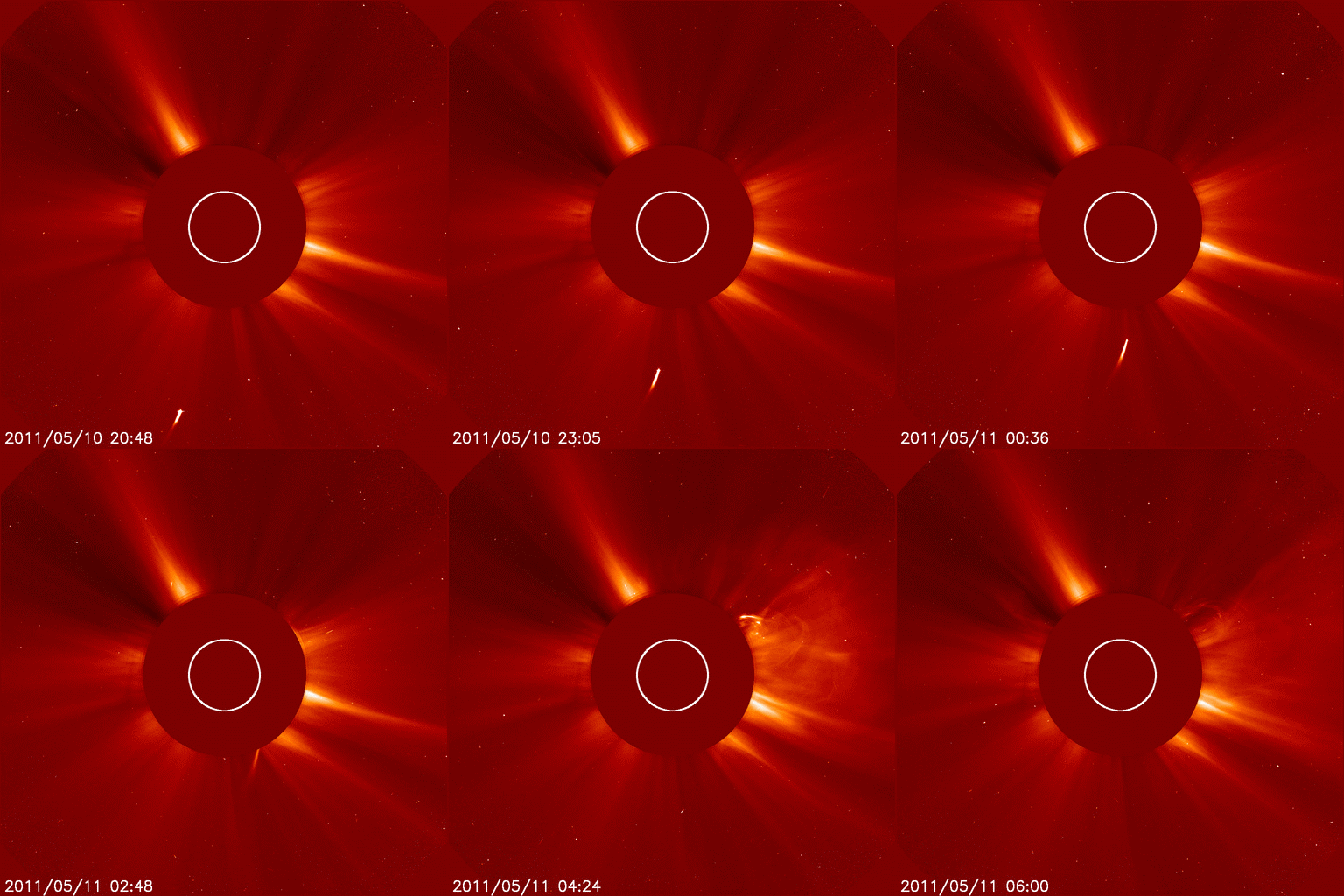
SOHO (NASA-ESA Solar & Heliospheric Observatory) watched as a fairly bright comet dove towards the Sun in a white streak and was not seen again after its close encounter (May 10-11, 2011). The comet, probably part of the Kreutz family of comets, was discovered by amateur astronomer Sergey Shurpakov. In this coronagraph the Sun (represented by a white circle) is blocked by the red occulting disk so that the faint structures in the Sun's corona can be discerned. Interestingly, a coronal mass ejection blasted out to the right just as the comet is approaching the Sun. Scientists, however, have yet to find a convincing physical connection between sun-grazing comets and coronal mass ejections. In fact, analysis of this CME using images from the Solar Dynamics Observatory shows that the CME erupted before the comet came close enough to the solar surface to interact with strong magnetic fields.
Gizmodo also ran something on this, stating:
Once in a while, a comet hits the Sun and our star goes all nomnomnom on it. SOHO—NASA's Solar & Heliospheric Observatory—has captured a few, but never so spectacularly as in this video...
These comets are called sungrazers, and 90% of them come from the Kreutz comet group, a family of comets that was detected by Sergey Shrupakov. The Kreutz was a giant comet that disintegrated many centuries ago. The pieces are still up there, way too close to the Sun's perihelion, and crash against its surface from time to time. This may be one of those pieces.
The first portion of this video is also posted at flikr.
-
mharratsc
- Posts: 1405
- Joined: Mon Jan 26, 2009 7:37 am
Re: NASA captures giant comet hitting sun
Don't have to actually touch your cat's nose to get him to discharge in the winter, either! 
Two instances of sungrazers causing CME's is coincidence, three is a trend, all of the reported ones put together over the years indicate...?
Two instances of sungrazers causing CME's is coincidence, three is a trend, all of the reported ones put together over the years indicate...?
Mike H.
"I have no fear to shout out my ignorance and let the Wise correct me, for every instance of such narrows the gulf between them and me." -- Michael A. Harrington
"I have no fear to shout out my ignorance and let the Wise correct me, for every instance of such narrows the gulf between them and me." -- Michael A. Harrington
-
beekeeper
- Posts: 141
- Joined: Mon Feb 22, 2010 8:53 pm
Re: NASA captures giant comet hitting sun
Greetings, very interesting video indeed. But somehow the first part of the video with the disk blocking the sun so that we can better view the events happening on the corona, appears to be a lot more violent then the second part where the comet seemingly enters the corona. In the second part an interesting point is not really the plasma ejection as much as the ripples that it seems to produce as it finds it's way into the plasma ball behind the CME. Thank you for the link.
If nothing can travel faster than light, how can darkness escape it
-
Maol
- Posts: 304
- Joined: Fri Mar 11, 2011 1:40 pm
Re: NASA captures giant comet hitting sun
I (and others) posted this in Planetary Science as a thread starter and admin moved it into a thread in Electric Universe and scolded me for doing it wrong, I have no idea why. I thought the “coincidence” worthy of discussion.
http://www.thunderbolts.info/wp/forum/phpB ... 678#p51678
http://www.thunderbolts.info/wp/forum/phpB ... 678#p51678
Maol wrote:
"There's no known way that the wispy, vaporous remains of a relatively lightweight comet could cause a billion-ton cloud of hot plasma to fly away from the sun at 400 km/s ...."http://spaceweather.com/
COMET AND CME: A comet dove into the sun on May 11th and seemed to trigger a massive eruption--emphasis on seemed. Watch the movie, then scroll down for further discussion.
A comet goes in; a CME comes out. Coincidence? Probably, yes, the sequence was coincidental. The comet disintegrated as much as a million kilometers above the stellar surface. There's no known way that the wispy, vaporous remains of a relatively lightweight comet could cause a billion-ton cloud of hot plasma to fly away from the sun at 400 km/s (the observed speed of the CME). Moreover, NASA's Solar Dynamics Observatory photographed the eruption that did propel the CME into space. There's no comet in the field of view of this must-see movie.
Bonus: The bright comet pictured above had a dim companion. Can you find it?
Oh. Really?
-
StefanR

- Posts: 1371
- Joined: Sun Mar 16, 2008 8:31 pm
- Location: Amsterdam
EPOXI Flyby of Hyper Comet
http://www.nasa.gov/mission_pages/epoxi ... 10616.htmlAfter visiting a comet and imaging distant stars for hints of extrasolar planets, you could say the spacecraft used for EPOXI had seen its fair share of celestial wonders. But after about 3.2 billion miles (5.1 billion kilometers) of deep space travel, one final wonder awaited the mission's project and science teams. On Nov. 4, 2010, the EPOXI mission spacecraft flew past a weird little comet called Hartley 2.
"From all the imaging we took during approach, we knew the comet was a little skittish even before flyby," said EPOXI Project Manager Tim Larson of NASA's Jet Propulsion Laboratory in Pasadena, Calif. "It was moving around the sky like a knuckleball and gave my navigators fits, and these new results show this little comet is downright hyperactive."
The EPOXI mission found that the strong activity in water release and carbon dioxide-powered jets did not occur equally in the different regions of the comet. During the spacecraft's flyby of the comet – with closest approach of 431 miles (694 kilometers) – carbon-dioxide-driven jets were seen at the ends of the comet, with most occurring at the small end. In the middle region, or waist of the comet, water was released as vapor with very little carbon dioxide or ice. The latter findings indicate that material in the waist likely came off the ends of the comet and was redeposited.
"Hartley 2 is a hyperactive little comet, spewing out more water than most other comets its size," said Mike A'Hearn, principal investigator of EPOXI from the University of Maryland, College Park. "When warmed by the sun, dry ice -- frozen carbon dioxide -- deep in the comet's body turns to gas jetting off the comet and dragging water ice with it."
Although Hartley 2 is the only such hyperactive comet visited by a spacecraft, scientists know of at least a dozen other comets that also are relatively high in activity for their size and which are probably driven by carbon dioxide or carbon monoxide.
"These could represent a separate class of hyperactive comets," said A'Hearn. "Or they could be a continuum in comet activity extending from Hartley 2-like comets all the way to the much less active, 'normal' comets that we are more used to seeing."
The study provides several new twists in the unfolding story of this small cometary dynamo, including: (1) Hartley 2 has an 'excited state of rotation' because it spins around one axis, but also tumbles around a different axis; and (2) on its larger, rougher ends, the comet's surface is dotted with glittering blocks that can reach approximately 165 feet (50 meters) high and 260 feet (80 meters) wide. The block-like, shiny objects, some as big as one block long and 16 stories tall, appear to be two to three times more reflective than the surface average.

The illusion from which we are seeking to extricate ourselves is not that constituted by the realm of space and time, but that which comes from failing to know that realm from the standpoint of a higher vision. -L.H.
-
TESLAKNEW
- Posts: 1
- Joined: Mon Jul 18, 2011 4:02 pm
Re: Electric Comets
I really think NASA don't really have much ideas of comets. I do think Wallace Thornhill has nailed it with the electrically charged theory. Why do they always insist it is water vapour/ice? It can't be if you are realistic about recent events.'exploding' comets etc. If the tail of Elenin does get near us it would be eventful I would think. we'll see I guess.
-
vatek1
- Posts: 12
- Joined: Sat Jun 25, 2011 4:22 am
Re: Electric Comets
James McCanney produced 3 papers on the Electrical Comet in the early 1980. McCanney is probably the foremost authority on the Electrical nature of Comets. I am not trying to take anything away from Mr. ThornHill, but just trying to give credit where credit is due to Dr. McCanney's work on the Solar Capacitor and the Electrical Discharge Comet model theory he wrote and published in 1980.
regards,
Forrest
regards,
Forrest
-
davesmith_au

- Site Admin
- Posts: 840
- Joined: Thu Mar 13, 2008 7:29 pm
- Location: Adelaide, the great land of Oz
- Contact:
Re: Electric Comets
Forrest, McCanney was long ago given the opportunity to collaborate on Electric Comet ideas with our group, and chose to threaten legal action instead, despite Thornhill et al basing their EC hypothesis on (and crediting) the work of others since the 1800s. There are significant differences between the two, not the least of which is that our EC hypothesis requires an Electric Universe. McCanney has been acknowledged by Thornhill where appropriate, the reverse cannot be said for McCanney. He is of the view that ANY talk of comets being electric has been stolen from him.
Cheers, Dave.
Cheers, Dave.
"Those who fail to think outside the square will always be confined within it" - Dave Smith 2007
Please visit PlasmaResources
Please visit Thunderblogs
Please visit ColumbiaDisaster
Please visit PlasmaResources
Please visit Thunderblogs
Please visit ColumbiaDisaster
-
nick c
- Site Admin
- Posts: 2483
- Joined: Sun Mar 16, 2008 8:12 pm
- Location: connecticut
Re: Electric Comets
hi Forrest,
If I remember correctly I read at least one of those papers that was published in Kronos. Although the use of the word "electric," is used by McCanney, his model has little else in common with the model proposed by Thornhill. In fact, they are opposites. McCanney proposed that comets are accreting material and are in the process of evolving into planets. In contrast, the Electric Comet model of Thornhill describes comets as having material being removed by a process similar to the industrial technique of electrical discharge machining. So basically, McCanney's model has nothing in common with the Electric Comet model as promoted on the Holoscience and Thunderbolts sites, other than the use of the word "electric".
Nick
As far as I know McCanney has never claimed the title of Dr.James McCanney produced 3 papers on the Electrical Comet in the early 1980. McCanney is probably the foremost authority on the Electrical nature of Comets. I am not trying to take anything away from Mr. ThornHill, but just trying to give credit where credit is due to Dr. McCanney's work on the Solar Capacitor and the Electrical Discharge Comet model theory he wrote and published in 1980.
If I remember correctly I read at least one of those papers that was published in Kronos. Although the use of the word "electric," is used by McCanney, his model has little else in common with the model proposed by Thornhill. In fact, they are opposites. McCanney proposed that comets are accreting material and are in the process of evolving into planets. In contrast, the Electric Comet model of Thornhill describes comets as having material being removed by a process similar to the industrial technique of electrical discharge machining. So basically, McCanney's model has nothing in common with the Electric Comet model as promoted on the Holoscience and Thunderbolts sites, other than the use of the word "electric".
Nick
-
Plasmatic
- Posts: 800
- Joined: Thu Mar 13, 2008 11:14 pm
Re: Electric Comets
And uhhh, did Mccanney ever hear of that one scientist who made an electric comet in the lab almost a hundred years ago??? Here's a hint , he discovered the electrical nature of the aurora .....
"Logic is the art of non-contradictory identification"......" I am therefore Ill think"
Ayn Rand
"It is the mark of an educated mind to be able to entertain a thought without accepting it."
Aristotle
Ayn Rand
"It is the mark of an educated mind to be able to entertain a thought without accepting it."
Aristotle
Who is online
Users browsing this forum: No registered users and 11 guests